
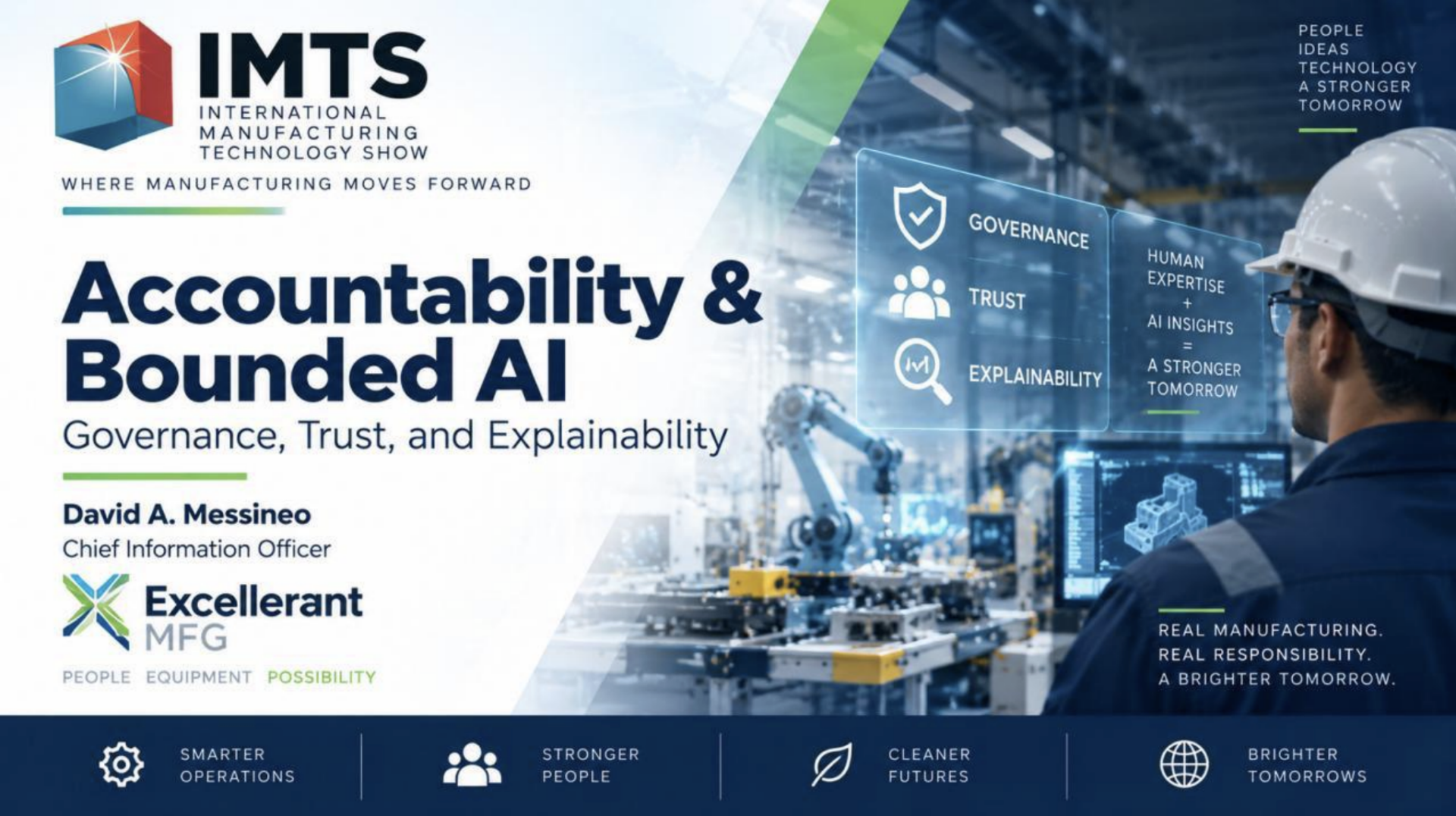
At IMTS 2026, David A. Messineo, Chief Information Officer at Excellerant, took the stage to address one of the most critical challenges facing modern manufacturing: how to turn the vast potential of Artificial Intelligence into trusted, real-world value on the factory floor.
We are excited to share the full presentation and a complete synopsis of the concepts discussed in the recent Aerospace Manufacturing and Design article regarding our conference session.
View the Presentation
You can view, download, or share the complete slide deck below:
Download the IMTS 2026 Bounded AI Governance Presentation by David A. Messineo
Synopsis: From AI Potential to Real-World Impact
As AI technologies mature, manufacturers are no longer just asking, “Will it work?” To scale these tools responsibly, the industry must answer two more consequential questions: “Should we let it?” and “Was it worth it?” Answering these questions requires a shift from simply implementing new software to establishing an AI governance architecture that preserves human authority while leveraging machine intelligence.
Key takeaways from the session include:
- The Reality of Bounded AI: Bounded AI refers to artificial intelligence that operates within predefined limits regarding what it can access, decide, recommend, or execute. Bounded AI is not less capable AI; rather, it is capability that operates within conditions that operations teams can explain, monitor, and own.
- Upgrading Accountability: Because AI operates at tremendous speeds and continuously learns, it acts as a new participant on the factory floor. Traditional RACI (Responsible, Accountable, Consulted, Informed) models must be expanded to track which actor (human or AI) is making decisions, how fast those decisions are made, and how the system improves from experience.
- The Three Levels of the Manufacturing System:
- Level 1 – Manufacturing / Convergence (“Will it work?”): This foundational level focuses on ensuring safe, reliable, and efficient operations that deliver quality products on time.
- Level 2 – Agency / Governance (“Should we let it?”): This level aligns AI with business objectives, defines boundaries for automated actions, and embeds AI into workflows with necessary human-in-the-loop checkpoints.
- Level 3 – Purpose / Emergence (“Was it worth it?”): This strategic level focuses on utilizing trusted AI to unlock sustainable value, resilient capabilities, and new opportunities for the workforce and industry.
- Earning Trust Through Governance: The goal of manufacturing is not to maximize autonomy, but to deliberately delegate the right autonomy based on risk and context. Good governance does not slow capability down; it establishes the boundaries, traceability, and safe fail-safes required to confidently expand AI utility.
The future of manufacturing isn’t found in a single, isolated AI use case. It is found in a governed portfolio of technologies—from predictive maintenance to computer vision for quality—that improve decisions, operations, and networks.
Ready to build a smarter, safer, and stronger tomorrow?
Review the complete insights in the Bounded AI Governance Slide Deck and reach out to the Excellerant team to discuss how we can help you build a trusted AI architecture on your factory floor.


