Introduction
In 2026, machines are running across thousands of shop floors. Most are producing parts. Far fewer are running at the efficiency their owners assume. Unplanned downtime costs manufacturers up to $1.7 million per hour, yet many facilities still rely on paper logs, clipboard rounds, and gut-feel decisions to manage production. The result: missed targets, hidden losses, and ERP systems that don't reflect shop floor reality.
OEE (Overall Equipment Effectiveness) software solves this by turning raw machine data into real-time visibility across three core metrics: Availability, Performance, and Quality. Choosing the right platform matters, especially for shops running mixed fleets of new and legacy equipment — a solution that can't connect to older CNCs will produce incomplete data and mislead production decisions.
This guide covers the top OEE software options for 2026, what to look for, and how to match a solution to your specific manufacturing environment.
Key Takeaways
- OEE software measures Availability, Performance, and Quality to benchmark production efficiency
- Top tools connect legacy and modern CNCs, sync with ERP systems, and replace paper-based tracking
- This guide covers five leading 2026 solutions: Excellerant, MachineMetrics, Vorne XL, Evocon, and Plex by Rockwell Automation
- Key selection criteria: machine connectivity, deployment complexity, real-time alerting, total cost of ownership
- Mixed-age equipment environments require universal protocol support and wireless DNC connectivity
What Is OEE Software and Why Does It Matter in Manufacturing?
OEE is the product of three factors: Availability (is the machine running when it should be?), Performance (is it running at the right speed?), and Quality (is it producing good parts?). OEE software automates the collection and calculation of these metrics across every machine on the floor, replacing manual tracking with real-time data capture.
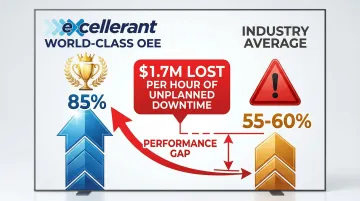
The industry OEE benchmark sits at 85%, established by Seiichi Nakajima in 1984. Yet most discrete manufacturers operate between 55-60%, revealing a massive gap between potential and reality. With unplanned downtime now costing manufacturers up to $1.7 million per hour, closing this gap is an economic imperative.
Much of that gap traces back to how manufacturers collect data. Traditional OEE tracking via clipboards and spreadsheets introduces problems that compound quickly:
- Lag: Data reviewed weekly instead of acted on in real time
- Inaccuracy: Human entry errors that distort root cause analysis
- Inaction: No mechanism to trigger alerts or corrective steps mid-shift
Modern OEE software connects directly to machine controllers, capturing live data and enabling shift-by-shift decisions rather than end-of-week reviews.
Best OEE Software Solutions for Manufacturing Monitoring in 2026
These solutions were selected based on machine connectivity breadth, real-time monitoring capability, ease of deployment, ERP/MES integration, and suitability across facility sizes. Each profile below covers key differentiators, ideal use cases, and pricing structure to help you match the right tool to your operation.
Excellerant
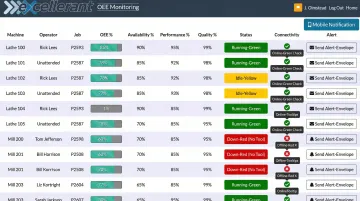
Excellerant is a Connecticut-based manufacturing technology company with 30 years of machine tool networking experience, offering real-time machine data collection and OEE monitoring with universal connectivity across any brand or protocol—including legacy CNC machines—alongside integrated wireless DNC software.
Key differentiators:
- Connects any mix of new and legacy machines without replacing equipment
- Unlimited client access with no additional per-user licensing fees
- USA-based technical support with deep machine tool expertise
- Integrated DNC software with one-click revision compare alongside OEE monitoring—a combination not offered by most standalone OEE tools
- Wireless connectivity options for older RS-232 serial machines
| Feature | Details |
|---|---|
| Key Features | Real-time OEE monitoring, universal machine connectivity (any brand/protocol), wireless DNC integration, shop floor to front office data flow, ERP data accuracy improvement, instant mobile notifications |
| Best For | CNC machine shops, aerospace, defense, and medical device manufacturers running mixed fleets of legacy and modern equipment in the US and Canada |
| Pricing Model | Contact-for-quote model; no per-user licensing fees for unlimited client access |
MachineMetrics
MachineMetrics is a Massachusetts-based industrial IoT platform designed specifically for discrete manufacturing, offering automated machine data collection from CNC controllers (Fanuc, Haas, Mazak, Siemens, and others) with real-time OEE dashboards and predictive analytics.
Key differentiators:
- Deep CNC protocol integration that eliminates manual part counting
- Spindle load monitoring to predict tool wear before breakage
- Analytics layer suited to engineering-driven shops seeking granular process data
- Out-of-the-box connectivity for any make and model of equipment, from legacy to modern
| Feature | Details |
|---|---|
| Key Features | Automated CNC data collection, spindle load and tool wear monitoring, real-time OEE and downtime categorization, production analytics dashboards |
| Best For | Precision machining and job shops with predominantly modern CNC equipment seeking deep machine-level analytics |
| Pricing Model | SaaS subscription based on machine count; edge devices required (pricing available on request) |
Vorne XL
Vorne is the established standard for visual factory hardware, offering plug-and-play OEE scoreboards that display real-time target-vs-actual production counts in large LED format directly on the shop floor.
Key differentiators:
- Immediate operator accountability through visible scoreboards
- Rugged industrial hardware designed for harsh shop floor environments
- Fast deployment measured in hours rather than weeks
- No software to install—all-in-one appliance with built-in reporting
| Feature | Details |
|---|---|
| Key Features | Real-time production count display, OEE calculation, downtime reason tracking, shift reporting, visual scoreboard hardware |
| Best For | High-speed assembly lines and manufacturers prioritizing simple, high-visibility shop floor accountability over deep analytics |
| Pricing Model | One-time hardware purchase; XL HD model priced at $4,290 (no recurring licensing fees) |
Evocon
Evocon is a cloud-based OEE tracking platform from Estonia with a global customer base, using simple IIoT sensor devices to detect machine stop/go signals and generate OEE reports—designed for manufacturers who want fast setup without complex IT integration.
Key differentiators:
- Intuitive traffic-light interface accessible to operators with minimal training
- Rapid deployment (days, not weeks)
- Clean SaaS model with no on-premise infrastructure required
- Highly rated for usability with 4.8/5 on Capterra
| Feature | Details |
|---|---|
| Key Features | Cloud OEE dashboard, IIoT stop/go signal detection, downtime reason logging, shift reports, multi-machine overview |
| Best For | General manufacturing facilities new to OEE tracking that need a lightweight, easy-to-deploy starting point |
| Pricing Model | Transparent SaaS tiers (priced in EUR): Basic (€159/month), Professional (€209/month), Enterprise (€269/month); IIoT devices required |
Plex by Rockwell Automation
Plex is an enterprise-grade cloud MES/ERP platform now part of Rockwell Automation, offering OEE monitoring as part of a broader production tracking system that covers raw material through finished goods with full part genealogy and traceability.
Key differentiators:
- End-to-end production visibility from a single platform
- Native integration with ERP and supply chain systems
- Required-level traceability for regulated industries like automotive and aerospace
- Named a Leader in IDC MarketScape for Manufacturing Execution Systems
| Feature | Details |
|---|---|
| Key Features | OEE monitoring within full MES suite, part genealogy and traceability, production scheduling, quality management, ERP integration |
| Best For | Enterprise automotive, aerospace, and regulated manufacturers needing OEE as part of a full MES/ERP deployment |
| Pricing Model | Enterprise SaaS (quote-based); professional services typically required for implementation—this is an ERP-level investment |
How We Chose the Best OEE Software for This List
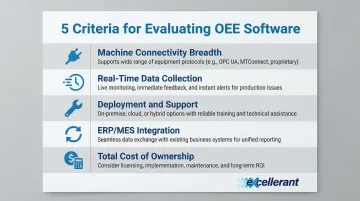
Our evaluation framework prioritized five criteria:
- Machine connectivity breadth: Supports legacy and mixed-protocol machines, not just modern MTConnect or OPC-UA — older equipment left unmonitored produces incomplete OEE data.
- Real-time data collection: Automated machine connectivity prevents the accuracy gaps that manual entry creates, enabling faster response to production issues.
- Deployment and support: Solutions with clear implementation paths and responsive support reach ROI faster; complex rollouts stall adoption.
- ERP/MES integration: OEE data that flows directly into planning systems eliminates manual re-entry and sharpens forecast accuracy.
- Total cost of ownership: Licensing structure (per-user vs. unlimited), hardware requirements, and ongoing support costs often outweigh the initial price tag.
The most common mistake manufacturers make when selecting OEE software is prioritizing dashboard aesthetics over connectivity. A tool that can't connect to all your machines—especially older CNCs—will produce incomplete data and mislead production decisions. Legacy equipment remains prevalent, with the median age of CNC machine tools in job shops at 7 years, and many still rely on RS-232 serial ports rather than Ethernet.
Facility size and industry context matter. A job shop with 15 legacy Fanuc machines has different requirements than a greenfield automotive plant. The tools that performed best in our evaluation earned it through connectivity depth and deployment simplicity, not marketing spend.
Conclusion
OEE software is only as valuable as the machine data feeding it. The right solution must connect to every machine on your floor—including older models—and deliver data that operators and managers can act on in real time, not the next morning.
Before committing to a platform, evaluate:
- Scalability — can it grow as you add machines or sites?
- Support responsiveness — is there a real team behind it, or a ticket queue?
- Domain depth — does the vendor understand machine tool environments, not just IoT software?
A solution built on genuine machine tool networking expertise will always outperform a generic IoT platform that was never designed for the shop floor.
If your facility runs mixed-age CNC equipment and needs a proven OEE and machine monitoring solution, Excellerant brings 30 years of machine tool networking experience, universal connectivity, and US-based support to the table. Contact the team at 860-870-5544 or sales@excellerant-mfg.com to discuss your specific setup.
Frequently Asked Questions
What are the most popular MES systems?
Leading MES platforms include Rockwell Automation (Plex), Siemens (Opcenter), and Infor, according to IDC MarketScape assessments. While MES and OEE software overlap, OEE tools can operate independently as a lighter-weight alternative for shops not ready for full MES deployment.
What does OEE software measure?
OEE software measures three factors — Availability (scheduled vs. actual run time), Performance (actual vs. ideal cycle time), and Quality (good parts vs. total parts produced) — multiplied together to produce a single percentage score.
What is a good OEE score in manufacturing?
World-class OEE is benchmarked at 85%, while the average for discrete manufacturers typically falls between 55-60%. Most shops that implement OEE tracking see a 10-15 point improvement within the first year simply by making downtime visible.
Can OEE software connect to legacy CNC machines?
Connectivity depends on the platform. Some OEE tools only support modern CNCs with MTConnect or OPC-UA. Solutions like Excellerant support legacy machines through universal protocol adapters and wireless DNC technology, covering older equipment running RS-232 serial connections.
How does OEE software integrate with ERP systems?
Most modern OEE platforms offer API-based or native connectors to common ERP systems (SAP, Oracle, Epicor), pushing production actuals directly into work order tracking, inventory, and scheduling — eliminating manual data entry and improving ERP accuracy.
How long does it take to implement OEE software?
Deployment time varies widely. Simple IIoT-based tools like Evocon can go live in days, while enterprise MES platforms like Plex require months. Hardware-connected solutions for mixed CNC environments typically deploy within weeks depending on machine count and protocol complexity.