Introduction
Industrial IoT adoption in 2026 has moved past the pilot phase. The global IIoT market is projected to reach $198.2 billion in 2025, with manufacturing claiming the largest share — and for good reason. Connected devices on factory floors and machine shops have become mission-critical infrastructure that determines whether manufacturers can compete on delivery, quality, and cost.
For manufacturers running mixed fleets of legacy and modern machines, the wrong connectivity choice creates costly downtime, data silos, and infrastructure that adds bottlenecks instead of eliminating them. With 18.5 billion connected IoT devices in 2024 growing at 14% year-over-year to 21.1 billion by end of 2025, getting the connectivity decision right has never mattered more.
This guide covers the top IoT connectivity solutions for industrial environments in 2026, the protocols that matter most for machine-heavy operations, and the trends reshaping how manufacturers connect their shop floors.
Key Takeaways
- Industrial IoT connectivity spans cellular (5G/LTE), Wi-Fi 6/6E, private networks, and wired protocols, each suited to specific manufacturing environments
- Leading providers range from enterprise telecom giants to specialized IIoT vendors built specifically for shop-floor machine integration
- Key 2026 trends include private 5G for factory floors, edge computing at the machine level, AI-driven predictive analytics, and mandatory cybersecurity frameworks
- Evaluate providers on protocol compatibility, legacy machine support, scalability, and total cost of ownership—not just brand recognition
What Is Industrial IoT Connectivity and Why It Matters in 2026
Industrial IoT (IIoT) connectivity is the infrastructure, protocols, and platforms that enable machines, sensors, and control systems on a factory floor to communicate, share data, and feed real-time intelligence to operations teams. Unlike consumer IoT—which prioritizes convenience in homes and personal devices—IIoT emphasizes machine-to-machine communication, operational reliability, and integration with enterprise systems like ERP and MES platforms.
The business case is concrete. Manufacturers using IIoT connectivity can expect measurable gains across several operational areas:
- Visibility into OEE (Overall Equipment Effectiveness) and real-time production status
- Reduced unplanned downtime through condition monitoring and early alerts
- Tighter production forecasting driven by actual machine data
- Closed-loop integration between shop floor equipment and front-office ERP systems
AI-driven predictive maintenance alone can reduce unplanned downtime by 30–50% and cut maintenance costs by 10–40%, with early adopters reporting ROI of up to 10x within 2–3 years.
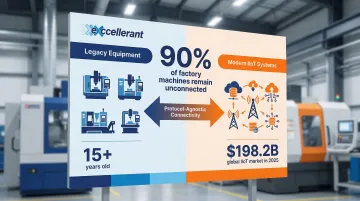
That ROI, however, depends on solving the industry's most persistent barrier: legacy machine integration. Most manufacturing facilities run mixed fleets—older CNC equipment operating alongside newer systems—and 90% of machines in factories worldwide remain unconnected, with the vast majority over 15 years old. Protocol-agnostic connectivity is a hard requirement in this environment. Evaluating solutions based on their ability to bridge this gap—not just connect new equipment—determines whether an IIoT investment delivers value or creates another data silo.
Top IoT Connectivity Solutions for Industrial Environments in 2026
These providers were selected based on industrial applicability, connectivity breadth, manufacturing use case strength, and ability to integrate with diverse machine environments—not just general IoT market presence. Whether you run a single CNC-heavy shop floor or a multi-site global operation, the right fit depends on your connectivity type, machine mix, and operational scale.
Verizon Business
Verizon Business leverages the nation's largest 5G network to deliver enterprise IoT connectivity solutions, including its Verizon Sensor Insights platform—a ready-to-deploy solution delivering near real-time, data-driven intelligence for industrial equipment monitoring.
Why it stands out: Nationwide 5G Reduced Capability (RedCap) coverage supports high-density IoT device deployments in large manufacturing campuses without requiring private network infrastructure investments. A 2025 survey indicates 74% of companies plan to adopt 5G RedCap due to its lower complexity and cost compared to standard 5G devices.
| Key Features | Verizon Sensor Insights for equipment monitoring, 5G nationwide coverage, IoT device management portal |
|---|---|
| Best For | Large manufacturing campuses or multi-site industrial operations needing scalable cellular IoT without private infrastructure |
| Connectivity Type | 5G / LTE cellular, with managed IoT SIM connectivity |
Celona
Celona delivers dedicated private 5G solutions for enterprises, letting manufacturers run critical machine communications on dedicated wireless networks isolated from general enterprise IT traffic. Its AerFlex platform was the industry's first cloud-controlled, access point-only private 5G solution.
Key differentiator: Private 5G provides manufacturers with deterministic, low-latency connectivity for time-sensitive applications like CNC machine monitoring, automated production lines, and real-time quality control—without relying on shared public networks. Cargill is testing AerFlex to connect satellite offices with warehousing operations, streamlining manufacturing and automating forklifts.
| Key Features | AerFlex private 5G, cloud-controlled network management, enterprise-grade isolation |
|---|---|
| Best For | Manufacturers needing dedicated, interference-free wireless networks for high-precision or automated shop floor operations |
| Connectivity Type | Private 5G (CBRS spectrum) |
Telit Cinterion
Telit Cinterion provides wireless communication modules, cellular connectivity plans, and IoT platforms tailored to industrial environments. Its deviceWISE Intelligence Suite enables AI agents to manage and automate workflows across factory floors.
What sets it apart: The combination of hardware modules, connectivity management, and AI-driven workflow automation makes it a full-stack option for manufacturers building new IIoT architectures from the device up. Applications include AI-powered visual inspection and autonomous industrial agents for factory floor optimization.
| Key Features | deviceWISE Intelligence Suite, industrial IoT modules, cellular connectivity plans, AI workflow agents |
|---|---|
| Best For | Industrial OEMs and manufacturers designing new IoT-enabled equipment or upgrading device communication hardware |
| Connectivity Type | Cellular (4G/5G), LPWAN, Wi-Fi |
Kore Wireless
Kore Wireless is a global IoT connectivity management provider offering multi-carrier SIM solutions, IoT platform management, and analytics across industries. Its OmniSIM simplifies connectivity management for multi-geography industrial operations.
The edge: Carrier-agnostic connectivity management and broad global roaming support—with access to over 500 networks in 202 countries—make Kore the right call for manufacturers with multi-site or international operations.
| Key Features | OmniSIM multi-carrier connectivity, IoT platform analytics, global device management |
|---|---|
| Best For | Multi-site or multinational manufacturers needing centralized, carrier-agnostic IoT connectivity management |
| Connectivity Type | Multi-carrier cellular (LTE/5G), global eSIM |
Excellerant
Excellerant is a Connecticut-based IIoT specialist whose machine tool networking roots go back to 1991. Founder John Carpenter—trained in electronics by the US Navy—developed the world's first wireless DNC connection to a machine tool in 2001, and the company has focused exclusively on shop-floor machine connectivity for manufacturers of all sizes ever since.
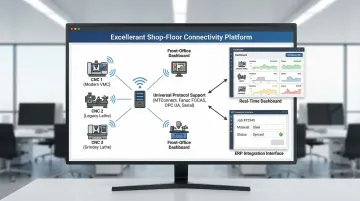
Built differently from the rest: Unlike enterprise telecom providers, Excellerant's strength is connecting any mix of machines—legacy CNC equipment and modern systems alike—using universal protocol support, wireless DNC technology, and real-time machine data collection with integrated ERP communication. No per-user licensing fees and USA-based support make it a practical fit for small-to-mid-size manufacturers.
| Key Features | Universal machine connectivity (any brand/protocol), wireless DNC, real-time machine data collection, ERP integration, one-click revision compare |
|---|---|
| Best For | Machine shops, CNC-heavy manufacturers, aerospace, defense, and medical device facilities needing shop-floor-to-front-office connectivity for mixed legacy and modern fleets |
| Connectivity Type | Wireless DNC, wired/wireless Ethernet, protocol-agnostic machine networking |
Emerging IIoT Connectivity Trends Shaping Industry in 2026
Private 5G and Wi-Fi 6E Adoption on Factory Floors
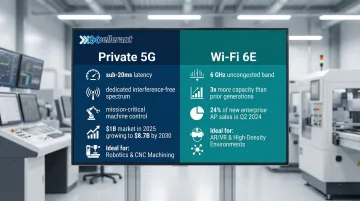
Manufacturers are moving from shared cellular networks toward dedicated private wireless networks to achieve the low latency and high device density required for real-time machine monitoring and automated production lines. Private 5G revenue in manufacturing is forecast to reach $1 billion in 2025 and $8.7 billion by 2030, representing a CAGR of 54.1%.
Private 5G, when paired with edge computing, enables sub-20 millisecond response times—essential for time-sensitive CNC applications, autonomous vehicle marshaling, and robotic coordination. BMW Group deployed a hybrid public-private 5G network at its Debrecen plant to support nearly 1,000 industrial robots and autonomous transport systems, enabling AI-powered automation and real-time quality control.
Where Private 5G handles mission-critical control, Wi-Fi 6E is gaining ground in high-density environments. In Q2 2024, **24% of new enterprise access point sales were Wi-Fi 6E**, which expands operation into the 6 GHz band and provides up to three times more capacity than previous generations. This uncongested spectrum is vital for factory floors with high device density, reducing interference and enabling predictable performance for bandwidth-heavy applications like AR/VR and wireless cameras.
Edge Computing at the Machine Level
Processing data locally—at or near the machine—rather than routing everything through the cloud reduces latency and enables faster decisions for equipment control and quality inspection. Global spending on edge computing is projected to reach $261 billion in 2025, growing to $380 billion by 2028, with manufacturing ranking as the second-largest sector for edge investment.
Factory environments generate massive volumes of sensor data—vibration, temperature, speed—that must be acted on immediately. Sending it all to the cloud introduces latency that critical control loops simply can't tolerate. Edge computing processes data at the source, delivering the sub-second response times safety and operations demand. One automotive assembly case study using real-time sensor data via MQTT recorded an 87.56% reduction in downtime and a 6.01% increase in line efficiency.
AI-Powered Predictive Analytics Integrated with IIoT Data
AI models fed by IIoT connectivity platforms enable manufacturers to predict equipment failures before they occur, optimize production scheduling, and detect quality anomalies in real-time. AI-driven predictive maintenance can reduce unplanned downtime by 30-50%, with companies adopting IoT-based predictive maintenance expecting a return of up to $7 for every $1 spent.
General Electric (GE) achieved a 50% reduction in unplanned downtime, saving $12 million annually after implementing predictive maintenance. The world's 500 largest companies lose approximately $1.4 trillion annually due to unplanned outages—roughly 11% of their total revenue—a cost that predictive analytics directly targets.
Cybersecurity as a Connectivity Requirement, Not an Afterthought
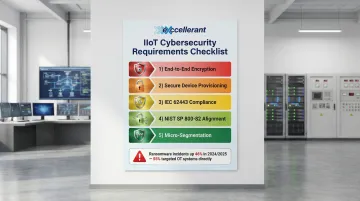
As more machines connect to networks, manufacturing environments face escalating cyber risk. Ransomware extortion incidents increased by 46% in late 2024/early 2025, and 55% of self-reported cybersecurity incidents in 2024 were direct attacks on operational technology (OT). Dragos tracked 26 active OT threat groups in 2025, with ransomware impacting over 3,300 industrial organizations.
Zero Trust Architecture (ZTA) for OT—verifying every user and device, assuming no implicit trust—is now standard practice, including micro-segmentation and least privilege access. When evaluating any IIoT connectivity provider, manufacturers should require:
- End-to-end encryption across all machine and network communications
- Secure device provisioning with authenticated enrollment
- IEC 62443 compliance for industrial automation security
- NIST SP 800-82 alignment for OT network security
- Micro-segmentation to contain breaches and limit lateral movement
Digital Twins Enabled by Real-Time Connectivity
Persistent, real-time machine data streams—made possible by robust IIoT connectivity—fuel digital twin models that allow manufacturers to simulate and optimize production without disrupting live operations. The digital twin market is projected to reach $35.82 billion in 2025 and $49.47 billion in 2026.
BMW Group uses digital twins of over 30 production sites to simulate and optimize processes. This "Virtual Factory" approach reduced production planning costs by up to 30% and cut collision check times from weeks to three days. Digital twin implementations for predictive maintenance show an average ROI of 15-25% over three years, while production line optimization twins deliver 10-15% ROI and 5-10% downtime reduction.
How to Choose the Right IoT Connectivity Solution for Manufacturing
Protocol and Machine Compatibility First
Manufacturers must evaluate whether a provider supports the specific communication protocols used by their existing machines—MTConnect, OPC-UA, FANUC FOCAS, Mazak, HAAS MNET, EtherNet/IP—and whether the solution can connect legacy equipment without expensive hardware replacement. This is the most common and costly mistake manufacturers make.
OPC UA is the most prominent standard for secure, platform-independent machine-to-machine communication, widely used for bridging OT and IT. MQTT is a lightweight publish/subscribe protocol ideal for constrained environments and cloud connectivity. MTConnect is specifically designed for exchanging data between manufacturing equipment (like CNCs) and software applications. If your provider doesn't support your machines' native protocols, you'll face costly middleware, data translation bottlenecks, or complete inability to connect critical equipment.
Scalability and Integration with Existing Systems
Evaluate how the connectivity platform integrates with existing ERP, MES, or DNC systems. A solution that creates data silos or requires manual data transfer negates the value of IIoT connectivity. Confirm the provider supports bidirectional data flow between shop floor and front office—enabling real-time synchronization that eliminates data time lag and increases ERP accuracy.
Platforms with Open API support connect directly to major enterprise software like SAP and Oracle. The system should automatically push manufacturing data to your ERP in real-time, including:
- Part completion status
- Conforming versus nonconforming part quantities
- Run-time and idle-time calculations
- Machine status updates
Total Cost of Ownership Beyond the Sticker Price
Hidden costs sink more IIoT budgets than the sticker price ever does. Before signing, get clarity on:
- Per-seat licensing fees and user access limits
- Ongoing support contract terms
- Hardware upgrade requirements
- Downtime expected during installation
For SMEs especially, complex integration is the biggest cost driver—so prioritize providers offering straightforward setup, unlimited client access, and US-based technical support.
The ROI case is straightforward: unplanned downtime costs industrial manufacturers approximately $50 billion annually, with individual incidents averaging $22,000 per minute. A connectivity solution that prevents even a few hours of downtime per year pays for itself quickly.
Vendor Expertise in Your Specific Industry
A provider with deep experience in manufacturing environments—not just general enterprise IoT—will understand the operational constraints of a shop floor, including 24/7 uptime requirements, machine protocol nuances, and the need to integrate with both legacy and modern equipment.
Providers serving aerospace, defense, and medical device manufacturing understand compliance requirements like ISO 9000 and CMMC. They know that quality processes often mandate one-program-per-machine requirements and that security isn't optional. Vendor expertise translates to faster implementation, fewer surprises, and solutions that work with your operational reality rather than requiring you to change processes to fit their platform.
Conclusion
The best IoT connectivity solution for an industrial environment isn't the one with the biggest brand—it's the one that fits the specific machine mix, protocol requirements, and operational scale of the facility. Manufacturers should resist the temptation to over-engineer with general enterprise platforms when specialized industrial connectivity tools may offer faster ROI and simpler implementation.
For manufacturers with mixed legacy and modern equipment, universal protocol support isn't a luxury—it's a necessity. For multi-site operations, centralized visibility and ERP integration determine whether IIoT delivers production data manufacturers can actually act on or just more noise. For high-precision industries like aerospace, defense, and medical manufacturing, compliance and security must be built into connectivity from day one.
Before committing to a platform, manufacturers should evaluate three things:
- Whether the solution connects legacy and modern machines without custom middleware
- Whether ERP/MES integration is native or bolted on as an afterthought
- Whether the vendor has direct experience in industrial environments—not adapted from consumer IoT or enterprise IT
That last point matters more than most vendors admit. Excellerant's team brings over 30 years of machine tool networking experience—dating back to the development of the world's first wireless DNC connection in 2001—and has built its platform specifically for shop floor realities. The ability to connect any machine to any system, from decades-old CNC equipment to modern IIoT-ready hardware, is what separates purpose-built industrial connectivity from repurposed enterprise software.
Frequently Asked Questions
What are the IoT connectivity trends for industry in 2025?
The leading IIoT trends shaping factory floors right now include:
- Private 5G and Wi-Fi 6E for low-latency shop floor applications
- Edge computing for local, real-time data processing
- AI-driven predictive maintenance, reducing downtime by 30-50%
- Zero Trust Architecture and strengthened cybersecurity frameworks
- Digital twin integration enabled by live machine data streams
What is the difference between IoT and IIoT connectivity?
IoT covers connected consumer and commercial devices — smart homes, wearables, and similar products. IIoT (Industrial IoT) focuses on machine-to-machine communication in manufacturing, prioritizing reliability, protocol specificity (MTConnect, OPC-UA), and deep integration with ERP and MES systems over consumer convenience.
What connectivity protocols are commonly used in industrial IoT?
Common industrial protocols include:
- MTConnect — CNC machine data exchange
- OPC-UA — secure, interoperable machine-to-machine communication
- MQTT — lightweight cloud connectivity
- FANUC FOCAS — FANUC-specific machine protocol
- EtherNet/IP — real-time industrial automation
Protocol compatibility is especially important for facilities running legacy CNC or automation equipment.
How does private 5G differ from public 5G for manufacturing use cases?
Private 5G provides manufacturers with a dedicated, interference-free wireless network with guaranteed low latency (sub-20 milliseconds) and high device density. Unlike shared public 5G, it offers greater control, security, and reliability for time-sensitive shop floor applications like autonomous robotics, real-time quality control, and CNC machine coordination.
Can legacy CNC machines be connected to modern IIoT systems?
Yes, legacy machines can be connected using protocol-agnostic connectivity solutions and DNC technology. Specialized providers like Excellerant are built specifically to bridge legacy equipment with modern IIoT platforms through wireless DNC adaptors, serial communications, and PLCs—without requiring full machine replacement.
What should manufacturers prioritize when evaluating IIoT connectivity providers?
Focus your evaluation on these five areas:
- Machine and protocol compatibility — does it support your specific equipment?
- ERP and MES integration — can it handle bidirectional data flow?
- Scalability — will it grow with your operations?
- Total cost of ownership — account for hidden licensing and support fees
- Manufacturing-specific experience — general IoT credentials aren't enough for shop floor environments