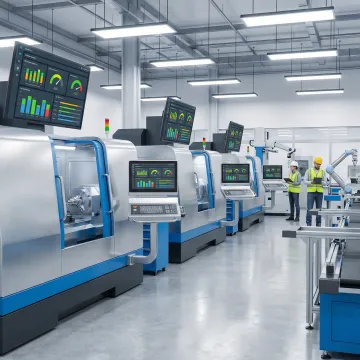
OEE (Overall Equipment Effectiveness) tracking is a manufacturing metric that measures how effectively production equipment is being utilized. It combines three key factors: Availability (actual operating time vs. planned production time), Performance (actual output vs. maximum possible output), and Quality (good parts vs. total parts produced). OEE tracking software automatically collects and calculates these metrics in real-time, providing manufacturers with a standardized way to identify losses, benchmark performance, and drive continuous improvement initiatives across their shop floor.
How do you implement OEE tracking?
Implementing OEE tracking begins with connecting your manufacturing equipment to a data collection system. Excellerant's solution uses universal connectivity hardware that works with any machine brand or age—modern CNCs connect via ethernet, while legacy equipment can use serial connections or PLCs. Once connected, the software automatically captures machine status, cycle times, and production counts without manual data entry. The final step involves configuring your ideal production parameters and training operators to use simple touchscreen interfaces for logging downtime reasons, enabling comprehensive and accurate OEE calculation.
OEE is measured using the formula: OEE = Availability × Performance × Quality. Availability is calculated as (Operating Time / Planned Production Time), Performance as (Actual Output / Maximum Possible Output), and Quality as (Good Parts / Total Parts Produced). Each factor is expressed as a percentage, and their product yields your overall OEE score. Excellerant's software automatically performs these calculations in real-time by collecting machine status data, counting production cycles, and recording quality outcomes—eliminating the need for manual calculations and providing instant visibility into equipment effectiveness.
What OEE percentage is considered good for manufacturing?
World-class manufacturing operations typically achieve OEE scores of 85% or higher, though this benchmark varies by industry. An OEE of 60% is often considered acceptable for many manufacturers, while scores below 40% indicate significant room for improvement. However, the most important aspect of OEE isn't hitting a specific number—it's establishing a baseline and driving continuous improvement. Excellerant's OEE tracking software helps you identify which of the three factors (availability, performance, or quality) is limiting your effectiveness, so you can prioritize improvement initiatives that deliver the biggest impact on your operations.
Can OEE tracking software work with old CNC machines?
Yes, Excellerant's OEE tracking software is specifically designed to work with any machine, regardless of age. While modern CNCs connect easily via ethernet or WiFi, legacy machines can be integrated using serial communications or by adding PLCs as intermediary devices. With 30 years of machine tool networking experience, Excellerant has successfully connected equipment spanning from 1980s-era CNCs to the latest Industry 4.0-ready machines—all reporting to a single unified dashboard for comprehensive shop floor visibility.
How much does OEE tracking software cost?
OEE tracking software pricing varies based on the number of machines being monitored and the specific features required. Excellerant offers flexible solutions that include hardware, software, and cloud services in a complete package. Unlike many competitors, we provide unlimited client access with no per-user licensing fees, so your entire team can view real-time data without additional costs. Contact our sales team for a customized quote based on your specific shop floor configuration and business requirements.
What's the ROI timeline for OEE tracking software?
Most manufacturers see measurable ROI within 3-6 months of implementing OEE tracking software. The immediate benefits include reduced manual data collection time, faster identification of production bottlenecks, and decreased unplanned downtime. Over time, the insights gained from continuous OEE monitoring enable strategic improvements in maintenance scheduling, process optimization, and resource allocation that compound returns significantly. Excellerant customers typically report 15-30% improvements in overall equipment effectiveness within the first year of implementation.
Does OEE software integrate with our existing ERP system?
Yes, Excellerant's OEE tracking platform features seamless bi-directional integration with major ERP and MES systems including SAP, Oracle, and others. Our Open API enables real-time data synchronization, automatically pushing accurate production data from the shop floor to your business systems and pulling work order information back to the machines. This eliminates the frustrating data time lag and manual entry errors that plague many manufacturers, ensuring your ERP always reflects current shop floor reality for confident forecasting and planning.