Introduction
Modern factory floors generate enormous amounts of machine data every shift: cycle times, alarm codes, utilization rates, part counts. Yet many manufacturers still rely on manual checks or siloed spreadsheets to track performance. That gap creates a costly blind spot. Unplanned machine downtime now costs global manufacturers an estimated $1.4 trillion annually, with automotive facilities losing up to $2.3 million per hour during stoppages.
A single unplanned stoppage triggers missed delivery windows, wasted labor hours, and eroded customer confidence. For aerospace, defense, medical device, and precision machining facilities, remote machine monitoring is no longer optional — it's the difference between catching a fault before a shift ends and explaining a late shipment to a customer.
This guide covers the top remote monitoring tools for factory operations in 2026, what makes each platform worth considering, and the key criteria for selecting the right solution for your shop floor—whether you're running a 10-machine job shop or a multi-facility enterprise.
Key Takeaways
- Remote monitoring tools collect real-time machine data—utilization, cycle times, fault codes—to reduce downtime and improve production efficiency
- Strong platforms connect both modern CNCs and legacy equipment without requiring hardware overhauls
- Evaluate platforms on protocol support (MTConnect, FANUC FOCAS, OPC-UA), ERP/MES integration depth, and how quickly you can deploy and see live data
- Top tools include Excellerant, Scytec DataXchange, Forcam FORCE IIoT, PTC ThingWorx, and Siemens Insights Hub
- Shops with mixed or older machine fleets should prioritize protocol flexibility and legacy compatibility before evaluating features
What Is Remote Monitoring in Factory Operations?
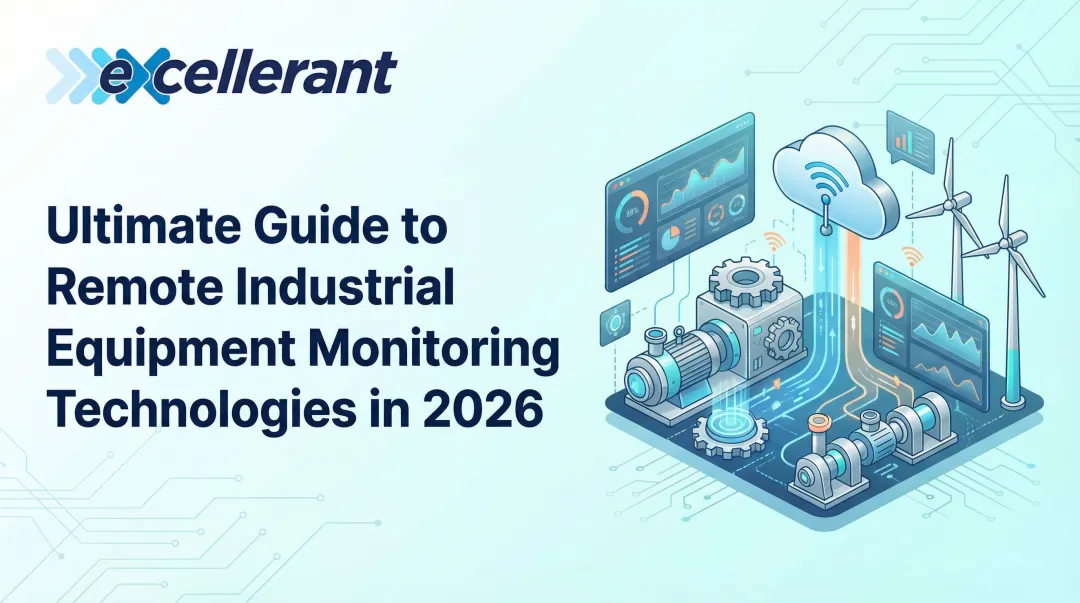
Remote monitoring in manufacturing refers to software and hardware systems that collect real-time data from machines, production lines, and factory assets. These platforms enable supervisors and engineers to track performance, detect faults, and make informed decisions from any location.
That's where the category distinction becomes critical. IT Remote Monitoring and Management (RMM) tools and factory IIoT platforms solve fundamentally different problems:
| IT RMM Tools | Factory IIoT Platforms | |
|---|---|---|
| Focus | Cybersecurity, software updates, network uptime | Machine uptime, OEE, cycle time, production output |
| Environment | Servers, endpoints, office networks | CNC machines, PLCs, robots, shop floor equipment |
| Protocols | TCP/IP, SNMP, RDP | MTConnect, OPC-UA, FANUC FOCAS |
| Common mistake | — | Using IT tools that can't communicate with CNC controls |
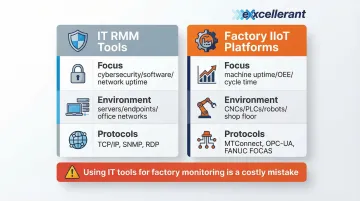
Using the wrong category of tool is a common and expensive mistake—IT tools simply lack the industrial protocol support required to connect to CNC controls.
The global Industrial IoT market is projected to surge from $483.16 billion in 2024 to $1.69 trillion by 2030, driven by manufacturers seeking to automate data collection and eliminate the manual processes still used by 70% of facilities. Every tool reviewed here was selected specifically for factory floor applicability—machine connectivity, real-time OEE visibility, and integration with production workflows, not general IT endpoint management.
Top Remote Monitoring Tools for Factory Operations in 2026
These tools were evaluated across seven criteria relevant to factory environments:
- Machine protocol support and legacy connectivity
- Real-time data accuracy and dashboard usability
- ERP/MES integration capability
- Deployment complexity
- Overall ROI potential for manufacturing operations
Excellerant
Excellerant is a veteran-owned manufacturing technology company with over 30 years of machine tool networking experience, founded from the lineage of Macdac Engineering (1991) and WireFreeCNC. The company pioneered the world's first wireless DNC connection to a machine tool in 2001 and has since developed a comprehensive IIoT platform purpose-built for shop floors.
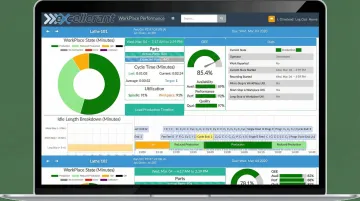
Excellerant's core advantage is universal machine connectivity: it integrates virtually any brand or age of CNC equipment using any protocol, eliminating the need for separate connectivity hardware on legacy machines. The platform includes real-time machine data visualization, integrated DNC software with one-click revision compare, and wireless DNC connection technology.
USA-based technical support is included with no additional per-user licensing fees, so unlimited client access scales with operations at no extra cost.
| Attribute | Details |
|---|---|
| Key Features | Real-time machine data collection and visualization, wireless DNC, universal protocol support (MTConnect, FANUC FOCAS, OPC-UA, Haas, Mazak, etc.), one-click NC program revision compare, shop floor to ERP data integration |
| Best For | CNC machine shops, job shops, aerospace, defense, and medical device manufacturers running mixed fleets of legacy and modern equipment |
| Deployment & Integration | USA-based installation and support; integrates with ERP and MES systems including SAP and Oracle; no additional licensing fees for unlimited client access |
Scytec DataXchange
Scytec DataXchange is a machine monitoring and data collection platform designed specifically for discrete manufacturers and CNC-heavy production environments. It connects to a wide range of machine tools to provide shop floor visibility through OEE dashboards and production reports.
DataXchange is widely recognized for its breadth of native machine connections, supporting over 100 machine types, with operator-level data capture that includes downtime reason codes and part count tracking. Deployment options span on-premise, commercial cloud (AWS), and a GovCloud option for facilities requiring ITAR or CMMC compliance.
Tech Manufacturing, an aerospace supplier, achieved a 15% increase in utilization after implementing DataXchange across both new and legacy CNCs.
| Attribute | Details |
|---|---|
| Key Features | OEE tracking, machine utilization dashboards, downtime reason codes, part count monitoring, shift reports, native connections to 100+ machine types, MTConnect and FANUC FOCAS support |
| Best For | Small to mid-size CNC job shops seeking out-of-the-box machine monitoring with minimal IT overhead |
| Deployment & Integration | On-premise, commercial cloud (AWS), or GovCloud; integrates with ERP platforms; licensing based on number of connected machines |
Forcam FORCE IIoT
Forcam is a Germany-based MES and IIoT platform provider with a global customer base in high-precision manufacturing sectors including aerospace, automotive, and medical devices. The company has maintained a strategic partnership with Excellerant since 2015, focused on bridging IIoT capabilities to large enterprise environments.
Forcam FORCE IIoT pairs machine monitoring with deep MES integration, connecting machine-level data directly into production scheduling, quality management, and ERP workflows. Its strength is enterprise-scale deployments where production data governance and traceability are non-negotiable.
Customers including Audi, BMW, and BorgWarner have reported OEE increases of at least 20% after implementation.
| Attribute | Details |
|---|---|
| Key Features | Real-time machine monitoring, MES integration, production scheduling, quality tracking, KPI dashboards (OEE, availability, performance, quality), connectivity via MTConnect and OPC-UA |
| Best For | Mid-to-large manufacturers in regulated industries requiring full MES-level traceability alongside monitoring |
| Deployment & Integration | Enterprise deployment; ERP and MES integration; enterprise contract pricing |
PTC ThingWorx
PTC ThingWorx is a leading industrial IoT application platform used by large manufacturers to build, deploy, and scale connected factory solutions. It is part of PTC's broader digital manufacturing ecosystem, which includes Vuforia (AR) and Windchill (PLM).
ThingWorx is built for manufacturers who need to develop custom IIoT applications using a low-code environment, covering everything from remote monitoring dashboards to predictive maintenance workflows. Flexibility and scalability across complex, multi-site environments are its defining strengths.
The platform combines industrial connectivity via Kepware with advanced analytics, machine learning, and augmented reality integration. SIG and Carlsberg have used ThingWorx to reduce downtime and improve OEE across global production lines.
| Attribute | Details |
|---|---|
| Key Features | Low-code IIoT app development, real-time data ingestion, predictive analytics, connectivity to industrial protocols (OPC-UA, MQTT, REST), integration with PTC PLM/ERP systems |
| Best For | Large manufacturers and OEMs requiring custom, scalable IIoT applications across multiple facilities or product lines |
| Deployment & Integration | Cloud or on-premise; broad protocol and ERP/PLM integration; enterprise licensing tiers |

Siemens Insights Hub
Formerly known as MindSphere, Siemens Insights Hub is an enterprise-grade industrial IoT platform designed to connect machines, plants, and systems at scale. It is deeply integrated into the Siemens Digital Industries ecosystem and targets large manufacturers seeking centralized production intelligence.
Insights Hub pulls data from across entire factory networks into a single view, with advanced analytics and AI-powered insights built in — including Production Copilot, which handles data analysis through natural language queries. Native integration with Siemens CNC and automation hardware makes it a natural fit for Siemens-heavy environments, though it supports third-party machine connections via OPC-UA and MQTT.
The platform is cloud-native and part of the Siemens Xcelerator portfolio.
| Attribute | Details |
|---|---|
| Key Features | Cloud-based machine data aggregation, AI-powered analytics (Production Copilot), energy monitoring, predictive maintenance, integration with Siemens CNC controls and third-party assets via OPC-UA |
| Best For | Large enterprises with Siemens automation infrastructure seeking enterprise-scale remote monitoring and advanced analytics |
| Deployment & Integration | Cloud-native (Siemens cloud); supports OPC-UA, MQTT, and Siemens-native protocols; subscription tiers |
How We Chose the Best Remote Monitoring Tools
Tools were assessed on their ability to serve actual factory floor use cases—not general IT environments. A common mistake manufacturers make is selecting IT-based RMM platforms marketed broadly as "monitoring tools" that lack CNC protocol support, or choosing enterprise IIoT platforms too complex for smaller job shops.
Machine Connectivity and Protocol Support
Tools that natively support key manufacturing communication standards—and can connect both modern and legacy machines without full hardware replacement—ranked highest. Core protocols evaluated include:
- MTConnect — provides a semantic vocabulary for manufacturing data, so "spindle speed" means the same thing across different machines
- OPC-UA — ensures secure and reliable data transport across networked equipment
- FANUC FOCAS — enables deep data extraction from FANUC controllers
- Haas, Okuma, Mazak — native controller integrations for common shop floor equipment
Platforms supporting this protocol mix can connect mixed-brand fleets without custom engineering work.
Real-Time Visibility and Alerting
Each platform was evaluated on whether it provides actionable real-time dashboards—OEE, machine utilization, downtime tracking—and configurable alerts that production managers can act on during a shift, not just after-the-fact reports. The goal is to shift maintenance from reactive to proactive, surfacing alerts for machine faults, idle states, and abnormal conditions immediately.
Integration and Scalability
Integration depth with existing ERP, MES, and DNC systems was a key factor, along with the ability to scale from a single job shop to a multi-facility operation without a platform change.
Platforms with open APIs and two-way data sync scored higher—they eliminate manual data entry and improve forecast accuracy by feeding live production data into scheduling, job costing, and inventory systems.
Ease of Deployment and Total Cost of Ownership
Deployment practicality matters as much as features. Platforms were scored on:
- Installation complexity — minimal on-site IT expertise required
- Vendor support quality — especially for legacy machine connectivity
- Licensing transparency — clear pricing with no hidden per-seat fees
- User access model — unlimited users without additional licensing costs
- Support location — USA-based support teams scored higher for responsiveness
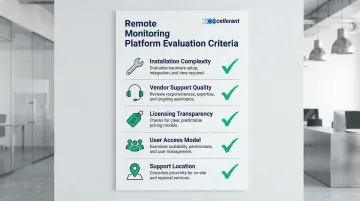
These factors directly affect total cost of ownership for shops without dedicated IT staff.
Conclusion
Choosing the right remote monitoring tool for factory operations is about matching the platform's capabilities to your specific machine mix, production goals, and IT maturity—not simply picking the most recognized brand. Top-performing manufacturers operate at 85% OEE, while the typical shop averages 60%. The gap between those numbers represents millions of dollars in recoverable productivity, and the right monitoring platform is the tool that closes it.
Before committing, evaluate platforms against three criteria—especially if your shop runs older CNC equipment alongside modern machining centers:
- Legacy machine compatibility: Can it connect to your existing equipment without hardware overhauls?
- Protocol support depth: Does it handle the full range of communication standards your machines use?
- Vendor technical support: Is a knowledgeable team available when integration issues arise?
Platforms that handle all three let you start collecting real machine data immediately, without waiting on infrastructure upgrades.
The team behind Excellerant brings over 30 years of machine tool networking experience, with the ability to connect virtually any machine regardless of brand or protocol. For manufacturers who want real-time visibility without the complexity of enterprise-scale platforms, that's a meaningful starting point. Contact Excellerant to walk through your specific shop floor setup and see how quickly your machines can be online.
Frequently Asked Questions
Frequently Asked Questions
What are the best remote monitoring tools for factory operations in 2026?
The leading platforms include Excellerant, Scytec DataXchange, Forcam FORCE IIoT, PTC ThingWorx, and Siemens Insights Hub. The best choice depends on your machine mix, shop size, and whether legacy machine connectivity is a priority.
What is the difference between factory remote monitoring tools and IT RMM software?
Factory monitoring tools collect data from CNC machines and production equipment using industrial protocols (MTConnect, OPC-UA, FANUC FOCAS), while IT RMM tools manage endpoints like computers and servers. The two serve completely different operational environments and are not interchangeable.
Can remote monitoring tools connect to older legacy CNC machines?
Yes—platforms like Excellerant are specifically designed to connect legacy machines using adapters, protocol translators, and wireless DNC adaptors for RS232 serial connections. This allows manufacturers to gain real-time visibility without replacing older equipment.
What data do factory remote monitoring tools typically collect?
These tools collect machine utilization rates, cycle times, spindle uptime, downtime events with reason codes, part counts, alarm and fault data, and program execution status. All of this feeds OEE calculations and production reports that give supervisors a clear picture of where time and capacity are being lost.
How do remote monitoring tools reduce machine downtime in manufacturing?
By surfacing real-time alerts for machine faults, idle states, and abnormal conditions, these tools allow supervisors to respond immediately rather than discovering problems after the fact. Catching issues as they happen — rather than hours later — keeps unplanned stoppages from compounding across a shift.
Do factory remote monitoring platforms integrate with ERP systems?
Most leading platforms integrate with ERP systems like SAP, Oracle, and Epicor, pushing actual production data into scheduling, job costing, and inventory modules. That live data feed replaces manual entry and makes production forecasts far more reliable.