Introduction
U.S. discrete manufacturers lose an estimated 15–20% of capacity to unplanned downtime every year — and most can't see it happening in real time. Labor costs keep climbing, supply chains stay unpredictable, and customers expect faster delivery with zero tolerance for defects. Traditional manufacturing — paper travelers, manual shift logs, siloed systems — was built for a different era. It wasn't designed to absorb this volume of pressure.
Industry 4.0 gets framed as a futuristic concept — something large enterprises worry about in five years. It isn't. Its competitive edge shows up today, on the shop floor: machines running longer between failures, maintenance scheduled before the breakdown happens, and ERP data that reflects what the floor is actually producing rather than what someone typed in at the end of a shift.
This guide covers the specific operational advantages Industry 4.0 delivers over traditional manufacturing, why those advantages compound over time, and what continued delay costs in downtime, scrap, and lost scheduling visibility.
Key Takeaways
- Industry 4.0 integrates IIoT, AI, automation, and real-time data to replace reactive, manual operations with connected, intelligent ones
- Core advantages over traditional manufacturing include real-time machine visibility, predictive maintenance, data-driven decisions, and measurable KPI tracking
- Manufacturers adopting these technologies reduce unplanned downtime, lower operating costs, and improve quality consistency
- Shops that skip the transition face rising error rates, reactive firefighting, and structural difficulty scaling
- Legacy equipment is not a barrier: Excellerant connects CNC machines of any brand, age, or protocol into one unified monitoring system
What Is Industry 4.0?
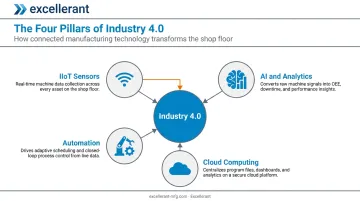
Industry 4.0 is the integration of digital technologies into manufacturing operations to create real-time connectivity between machines, people, and systems. Core technologies include:
- IIoT sensors that capture live machine data
- AI and analytics that turn that data into decisions
- Cloud computing that makes data accessible across the operation
- Automation that acts on insights without waiting for human input
NIST describes it as connecting machines, people, and physical assets into an integrated digital ecosystem that generates, analyzes, and communicates data — and can act without human intervention.
This is not a boardroom initiative or an IT project. It lives on the shop floor, across machine tools, production lines, and the supply chain.
In practical terms, Industry 4.0 is the infrastructure that gives manufacturers visibility and control over their operations — from job scheduling to quality assurance. The technology exists to drive measurable outcomes on the floor, not as an end in itself.
Key Advantages of Industry 4.0 Over Traditional Manufacturing
Each advantage below connects directly to outcomes manufacturers already track: uptime, throughput, defect rates, labor efficiency, and production costs.
Real-Time Machine Visibility
In traditional manufacturing, machine status is reported after the fact. Operators notice a stoppage; supervisors piece together what happened from shift logs or verbal handoffs. By the time anyone understands the problem, the schedule is already slipping.
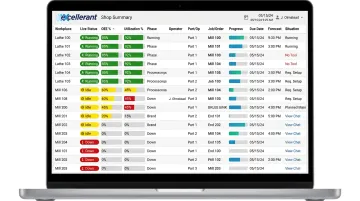
Industry 4.0 replaces this with continuous, live data from every connected machine on the floor. IIoT sensors and machine monitoring software collect run, idle, and fault states; cycle times; and utilization rates — displayed on centralized dashboards accessible to both floor operators and front-office managers simultaneously.
Excellerant's IIoT platform does this for any mix of machines, new or legacy CNC, under a single monitoring system. Modern CNCs connect via Ethernet or WiFi. Older serial-controlled machines connect through RS-232 adaptors or PLC intermediary devices. The result is one unified view across the entire shop floor, with no equipment replacement required.
Why this matters:
- Eliminates blind spots that cause scheduling errors, missed targets, and inter-department finger-pointing
- Enables managers to intervene before a minor slowdown becomes a missed deadline
- Feeds visibility data directly into job costing, capacity planning, and shift scheduling
Still, 70% of manufacturers collect data manually, according to the Manufacturing Leadership Council. The majority of shops are operating without the real-time picture their competitors are building.
KPIs impacted: OEE, machine utilization rate, average cycle time, shop floor-to-front office communication lag, ERP data accuracy
When it matters most: Real-time visibility delivers the highest ROI in high-mix, low-volume environments — aerospace, defense, and medical manufacturing — where every machine's availability is critical to on-time delivery and traceability requirements. McMellon Bros., an Excellerant customer, put it directly: "I can pull up ERP at any time and find out what's happening with a customer's parts. If we're not on pace, we can fix it."
Predictive Maintenance and Reduced Unplanned Downtime
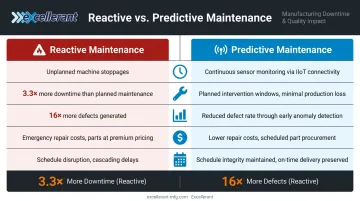
Traditional manufacturing runs on reactive or scheduled maintenance. Machines get fixed after they break, or inspected on a calendar cycle regardless of actual wear. Neither approach catches failure before it happens.
Industry 4.0 introduces predictive maintenance: connected sensors monitor vibration, temperature, and cycle deviation. When readings drift from baseline, automated alerts flag the issue so maintenance teams can intervene during planned downtime windows, not emergency shutdowns.
Why this matters:
According to Fluke Reliability, 55% of U.S. manufacturers were hit by unplanned downtime in the past year. The costs compound fast:
- Production stops and downstream jobs back up
- Delivery commitments get missed
- Emergency repair costs far exceed planned servicing
- Machines running out of spec produce defective parts that pass initial inspection — creating quality escapes that are expensive to catch and harder to explain to customers
NIST research found that manufacturing establishments with the highest reliance on reactive maintenance experienced 3.3 times more downtime and 16 times more defects than those with the lowest reliance. That gap is not marginal — it's a structural disadvantage.
Excellerant's platform supports predictive alerting through a rule engine that incorporates machine sensor and control data into its analytics suite. When the system detects an anomaly, it pushes real-time notifications through the mobile app to the right personnel immediately — whether they're on the floor or off-site.
KPIs impacted: MTBF, MTTR, unplanned downtime hours per month, maintenance cost as a percentage of asset value, scrap and rework rates
When it matters most: Predictive maintenance delivers the highest impact with aging equipment, high machine utilization rates, or precision machining applications where minor tool wear translates directly into out-of-spec parts.
Data-Driven Decision Making and ERP Accuracy
In traditional manufacturing, scheduling, inventory, and capacity decisions rely on manual reports, outdated spreadsheets, or gut instinct. The gap between what's actually happening on the floor and what the ERP believes is happening can be enormous.
Industry 4.0 closes that gap. Machine data — actual cycle times, job completion status, scrap counts, part counts — is captured automatically and reconciled with ERP records in real time. Manual labor tickets, paper travelers, and verbal shift handoffs are replaced with automated data capture.
Why this matters:
Inaccurate ERP data creates a cascade of operational problems:
- Inflated or unreliable lead time quotes to customers
- Wrong inventory levels triggering unnecessary purchases or shortages
- Missed delivery commitments from schedules built on stale floor data
- Poor resource allocation from capacity plans that don't reflect reality
A 2025 Deloitte smart manufacturing survey found that manufacturers implementing smart manufacturing reported average net impacts of 10–20% production output improvement and 7–20% employee productivity improvement. Manual data entry is a significant contributor to that gap — with research showing that even a 1% manual entry error rate can corrupt 40% of records in a two-phase entry system.
Excellerant's bi-directional ERP integration addresses this directly. The platform connects with SAP, Oracle, Epicor, JobBoss, and Global Shop Solutions, pushing actual cycle times, part counts, good versus scrap quantities, and actual hours to the ERP in real time — while pulling job and work-order data back to the shop floor.
C&M Machine Products reported after deployment: "The accuracy of information coming into our ERP system is exponentially better than what it was before. We have been able to improve the accuracy of our costs and increase our value to our customers."
KPIs impacted: ERP data accuracy rate, schedule adherence, on-time delivery rate, production reporting time, job costing variance, inventory accuracy
When it matters most: ERP accuracy is most critical in shops running complex, multi-operation jobs — CNC machining, medical device, and defense manufacturing — where job traceability and audit trails are mandatory for compliance.
What Happens When Industry 4.0 Is Ignored
Staying on traditional, disconnected systems doesn't just mean missing out on efficiency gains. It creates compounding operational drag that gets harder to reverse over time.
The consequences accumulate predictably:
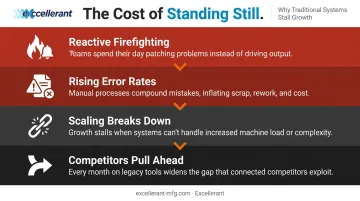
- Reactive firefighting becomes the default — supervisors spend shifts chasing machine problems and schedule conflicts instead of improving processes
- Error rates creep up — manual data entry and paper-based work orders introduce transcription mistakes, missed revisions, and miscommunications between engineering and the floor
- Scaling gets structurally harder — adding machines, shifts, or customers to a manual system doesn't scale linearly; it multiplies coordination overhead and compounds the risk of mistakes
- Competitors pull ahead — shops that have adopted IIoT and real-time monitoring can quote faster, deliver more reliably, and win on service quality even when price is comparable
Deloitte's 2025 survey found that 92% of manufacturers identified smart manufacturing as the primary driver of competitiveness over the next three years. Shops already running IIoT and real-time monitoring are compressing quote cycles and tightening delivery windows — widening the gap on shops that haven't moved yet.
How to Get the Most Value from Industry 4.0
Adoption works best when it starts with connectivity. Getting accurate, real-time data out of machines already on your floor, before layering on advanced analytics or automation, creates the foundation everything else depends on — and delivers measurable results from day one.
Three principles for extracting real value:
- Start with machine monitoring — real-time visibility into run, idle, and fault states gives managers the information they need to make better scheduling, staffing, and maintenance decisions from day one
- Act on the data — dashboards and reports only deliver value when the management team uses them to change decisions; visibility without action is overhead
- Don't wait for new equipment — legacy CNC machines are not a barrier; IIoT platforms designed for universal machine connectivity can connect any brand, age, or protocol into the same monitoring system
Excellerant's platform is built specifically for this incremental adoption model. It connects modern CNCs via Ethernet or WiFi and legacy machines via serial communications or PLC adaptors, supporting Fanuc FOCAS, HAAS MNET, Mazak Mazatrol, MTConnect, and OPC-UA, among others. Unlimited client access means operators, managers, and executives all work from the same real-time data — no additional licensing costs as the team grows.
That shared visibility feeds directly into production decisions. The finite dynamic scheduling system closes the loop with live machine status and OEE feedback, reschedules dynamically against real shop-floor conditions, and gives managers accurate completion time forecasts without manual recalculation.
Conclusion
The core advantage Industry 4.0 holds over traditional manufacturing is the shift from operating blind and reactive to operating with real-time visibility, control, and predictive capability across every machine and process on the floor.
Real-time visibility, predictive maintenance, and accurate data-driven decisions don't just improve individual metrics in isolation — they compound. Each improvement feeds the next, widening the gap between connected manufacturers and those still running on manual systems. For shops ready to close that gap, the practical starting point is connecting machines to a unified monitoring platform — so every production decision is backed by live data, not guesswork. Excellerant helps discrete manufacturers and job shops do exactly that, connecting any machine, any age, to real-time OEE analytics and shop-floor visibility tools that make Industry 4.0 practical from day one.
Frequently Asked Questions
What are the benefits of Industry 4.0 in manufacturing?
The primary operational benefits are improved machine utilization, reduced unplanned downtime, lower defect and scrap rates, and better ERP accuracy. Combined, these translate into faster delivery, more reliable quality, and the ability to make production decisions based on what's actually happening on the floor — not what was recorded hours earlier.
What is the difference between Industry 4.0 and smart manufacturing?
The terms are largely synonymous in practice. Industry 4.0 is the broader framework for the fourth industrial revolution; smart manufacturing refers to applying those technologies — IIoT, AI, automation — on the production floor. NIST treats smart manufacturing and IIoT as components within that broader Industry 4.0 framework.
What is the difference between Industry 4.0 and traditional manufacturing?
Traditional manufacturing is reactive, manual, and siloed — systems know something went wrong after the fact. Industry 4.0 is connected, data-driven, and proactive — it detects problems as they happen or before they do. The core difference is visibility and response time.
How does Industry 4.0 reduce downtime in manufacturing?
IIoT sensors monitor machine health continuously, enabling predictive maintenance that flags potential failures before they cause unplanned stoppages. This shifts maintenance from reactive emergency repairs to planned, lower-cost interventions, keeping production on schedule rather than scrambling to recover.
Can small or mid-size machine shops adopt Industry 4.0 technologies?
Yes. Cloud-based monitoring platforms scale to any shop size, and IIoT solutions for legacy CNC equipment remove the need for full machinery replacement. Entry costs are lower than most shops expect, and ROI from reduced downtime and improved ERP accuracy typically comes quickly.
What is IIoT and how does it relate to Industry 4.0?
IIoT (Industrial Internet of Things) is the network of connected sensors, devices, and machines that collect and exchange real-time production data. It is the foundational technology layer of Industry 4.0 — without IIoT connectivity, the data needed for AI, predictive maintenance, and real-time decisions does not exist.