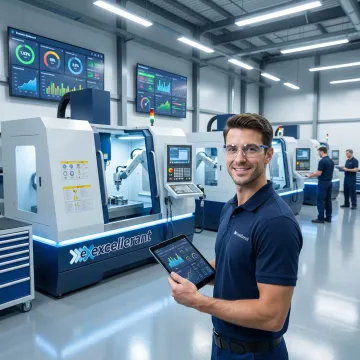
What is MES in the automotive industry?
MES (Manufacturing Execution System) in the automotive industry is a comprehensive software platform that manages and monitors production processes in real-time on the shop floor. It connects machines, operators, and enterprise systems to provide complete visibility into manufacturing operations, track quality metrics, ensure traceability for regulatory compliance, and optimize production efficiency. Automotive MES solutions capture data from CNC machines, assembly stations, and quality inspection equipment to support just-in-time manufacturing, coordinate complex supply chains, and maintain the stringent documentation required by standards like IATF 16949.
How does MES software integrate with existing automotive ERP systems?
Excellerant's MES platform provides seamless bi-directional integration with major ERP systems like SAP and Oracle through Open API connectivity. Real-time data synchronization eliminates manual data entry by automatically pushing shop floor production data, quality results, and inventory transactions to your ERP while pulling work orders, BOMs, and scheduling information back to the shop floor. This integration ensures your business systems always reflect current production reality, improving inventory accuracy, enabling confident forecasting, and supporting better decision-making across your automotive manufacturing operation.
Can Excellerant's MES connect to legacy automotive manufacturing equipment?
Yes, Excellerant specializes in universal machine connectivity regardless of equipment age, brand, or communication protocol. Our solutions connect modern CNCs through standard ethernet or WiFi, while legacy presses, injection molders, and assembly equipment connect via serial communications or PLCs as intermediary devices. We support protocols including MTConnect, OPC UA, Fanuc Focas, HAAS MNET, and Mazak Mazatrol, ensuring your entire automotive production environment—both legacy and modern equipment—can be integrated into a single, unified MES platform.
What are the typical ROI timeframes for automotive MES implementations?
Most automotive manufacturers see measurable ROI within 6-12 months of MES implementation through reduced downtime, improved OEE, elimination of manual data entry, better inventory accuracy, and fewer quality escapes. Common benefits include 15-30% reduction in unplanned downtime, 10-20% improvement in overall equipment effectiveness, significant labor savings from automated data collection, and improved on-time delivery performance. The exact ROI depends on your current operational efficiency, production volume, and specific pain points addressed by the MES solution.
How does MES software support automotive quality and compliance requirements?
Excellerant's MES platform maintains comprehensive production traceability by automatically documenting every manufacturing step, part revision, operator action, and quality check point. This creates an auditable record that supports IATF 16949 compliance, enables rapid root cause analysis when defects occur, and facilitates efficient recall management. The system tracks part genealogy, links quality data to specific production runs, and generates compliance reports—ensuring automotive suppliers meet stringent quality standards while reducing the administrative burden of manual documentation.
What training and support does Excellerant provide for automotive MES implementations?
Excellerant provides comprehensive training programs tailored to each user group in your automotive manufacturing operation. Operators receive hands-on training with intuitive shop floor interfaces, supervisors learn real-time monitoring and analytics capabilities, and managers master strategic reporting tools. Our USA-based technical support team, led by experienced manufacturing professionals, provides ongoing assistance including system optimization guidance, troubleshooting support, and regular performance reviews to ensure your MES solution evolves with your automotive manufacturing needs.
How long does a typical automotive MES implementation take?
Implementation timelines vary based on the size and complexity of your automotive manufacturing operation. A single production cell can often be deployed in 2-4 weeks, while comprehensive multi-line implementations typically take 2-4 months. Our phased approach minimizes disruption by starting with pilot areas, validating performance, and then scaling to additional production zones. We work closely with your team to schedule installations around production commitments, ensuring minimal impact on automotive manufacturing output and just-in-time delivery obligations.
What are the ongoing costs and licensing requirements for Excellerant's MES platform?
Excellerant's cloud-based MES platform operates on a subscription model with transparent pricing and no hidden fees. A key advantage is unlimited client access with no per-user licensing costs—you can add as many operators, supervisors, and managers as needed without additional charges. Pricing is based on the number of connected machines and selected modules, making it predictable and scalable as your automotive manufacturing operation grows. Our USA-based technical support is included, ensuring you have expert assistance whenever needed.