Introduction
Most manufacturers understand what Industry 4.0 is. The harder problem is actually implementing it.
Industry 4.0 implementation is the structured, phased process of integrating smart technologies into manufacturing operations — IIoT, real-time data collection, automation, and analytics — to improve efficiency, visibility, and decision-making. That definition sounds straightforward.
The reality involves legacy equipment, mixed protocols, skeptical operators, and the constant temptation to buy technology before defining what problem it solves.
This guide is written for manufacturing facilities and machine shops — from job shops running mixed-age CNC equipment to aerospace and defense suppliers navigating tighter compliance requirements. If you're past the awareness stage and trying to figure out what implementation actually involves, this is your roadmap.
We'll cover the six-step implementation process, the factors that determine whether it succeeds, and the mistakes that cause even well-resourced projects to stall.
Key Takeaways
- Industry 4.0 implementation is a phased operational transformation — not a single technology purchase
- Start with a digital maturity assessment before selecting or purchasing any technology
- Machine connectivity comes first — without reliable floor data, analytics deliver nothing
- Most shops can connect legacy CNC equipment without replacing it
- Most failures come from automating broken processes, skipping pilots, or neglecting change management
What Is Industry 4.0 Implementation?
Industry 4.0 implementation is the structured, phased adoption of interconnected digital technologies — IIoT, cloud computing, machine monitoring, robotics, and advanced analytics — to transform how a manufacturing facility operates and makes decisions.
A successful implementation is designed to deliver:
- Live machine performance data so supervisors can act on problems as they happen, not after the shift ends
- Automated data collection that eliminates manual tracking and paper-based records
- Fewer unplanned stoppages through continuous monitoring and predictive maintenance
- Direct communication between the shop floor and front-office ERP or scheduling systems
Purchasing technology and implementing it are not the same thing. A machine monitoring system only delivers results when it's connected to defined goals, clean data sources, trained operators, and a clear process for acting on what the data reveals. Many manufacturers invest in the right tools and still see underwhelming results — not because the technology failed, but because the implementation approach did.
Why Industry 4.0 Implementation Matters for Manufacturing
The pressures pushing manufacturers toward Industry 4.0 are real and compounding. Labor shortages, rising customer expectations, tighter tolerances, and the need for accurate production forecasting all converge on the same need: better data, faster decisions.
According to the Manufacturing Institute and Deloitte, manufacturers may need as many as 3.8 million additional employees between 2024 and 2033, with nearly half of those roles potentially unfilled. Automation and IIoT don't replace people — they help existing teams do more with better information.
The maintenance economics alone make a compelling case. NIST research found that manufacturers in the top quartile of reactive-maintenance reliance experienced 3.3x more downtime and 16x more defects than those in the bottom quartile. Facilities that adopted predictive maintenance approaches saw 87% lower defect rates and 15% less downtime.
Industry 4.0 Is Not Just for Large Manufacturers
Small and mid-size shops often hesitate, assuming Industry 4.0 requires enterprise-scale budgets. It doesn't. Phased deployment models, simplified IIoT platforms, and protocol-agnostic connectivity solutions have made implementation accessible for shops of any size.
Smaller machine shops frequently see faster ROI than large facilities. The reasons are straightforward:
- Shorter deployment cycles with fewer systems to integrate
- Immediate visibility into a more contained operation
- Quicker feedback loops between data collection and floor-level action
Aerospace suppliers, defense contractors, and job shops with 20–80 machines are ideal candidates for high-impact, focused implementations.
How to Implement Industry 4.0: A Step-by-Step Roadmap
Each phase builds on the previous one. Skipping steps (particularly the assessment and pilot phases) is the primary cause of implementations that stall or never deliver measurable value.
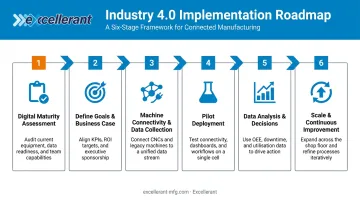
Step 1: Conduct a Digital Maturity Assessment
Before selecting any technology, conduct an honest audit of where you currently stand. This means documenting:
- Which machines exist on the floor, their ages, brands, and control types
- How production data is currently collected (manually, digitally, or not at all)
- Where the largest operational pain points are (downtime, scheduling accuracy, scrap rates, job tracking delays)
- What ERP or MES systems are in use and how shop floor data currently reaches them (if at all)
NIST's Smart Manufacturing System Readiness framework evaluates readiness across organizational, IT, performance management, and information-connectivity dimensions — a useful starting structure. McKinsey case work found that a targeted network scan across 40+ factories identified roughly 20 sites holding 80% of total savings potential. The same logic applies within a single facility: a two-hour floor audit will surface the two or three problems that account for most of your avoidable losses.
This step defines your starting point and separates quick wins from longer-term projects.
Step 2: Define Goals and Build a Business Case
Audit findings mean nothing without specific, measurable targets attached to them. Translate what you found into defined goals:
- Reduce unplanned downtime by X%
- Eliminate manual job tracking and paper-based data entry
- Improve OEE from current baseline to target figure
- Close the gap between shop floor actuals and ERP records within one shift
For each goal, compare projected ROI across potential solutions before committing to any investment. McKinsey reports that successful Industry 4.0 implementations can achieve 30–50% reductions in machine downtime, 10–30% throughput gains, and 15–30% labor productivity improvements — but only when implementations are tied to clear objectives and measured consistently.
Step 3: Establish Machine Connectivity and Data Collection
Connecting machines to a network so that real-time performance data flows automatically is the foundational technical step. Everything downstream (OEE dashboards, predictive maintenance alerts, ERP integration) depends on reliable, automated data from the floor.
Many shops hesitate here, assuming legacy equipment is a barrier. It isn't. Modern CNCs connect via ethernet or WiFi. Legacy RS-232 serial machines connect through wireless DNC adaptors or PLC intermediary devices, with no modification to the machine itself. Solutions like Excellerant's platform support any machine mix on a single unified dashboard, covering protocols including:
- Fanuc FOCAS
- HAAS MNET
- Mazak Mazatrol
- MTConnect
- OPC-UA
A shop running 40-year-old machines alongside new CNCs can see all of them in one place. Without this automated data layer, every analytics and automation step above it has nothing to build on.
Step 4: Pilot in One Area Before Full Rollout
Select one production cell, machine group, or process to validate your chosen solution before committing to facility-wide deployment. The pilot serves three purposes:
- Confirms expected ROI in your specific environment with your specific machines and workflows
- Surfaces integration issues early, when they're inexpensive to resolve
- Builds internal confidence — operators and managers who see real results in one area become advocates for broader rollout
McKinsey's research on digital manufacturing describes "pilot purgatory" — a state where manufacturers run successful pilots but never scale. The solution is to define scaling criteria before the pilot begins, not after. Know what success looks like, measure it, and build the expansion plan in parallel.
Step 5: Analyze Data and Enable Data-Driven Decisions
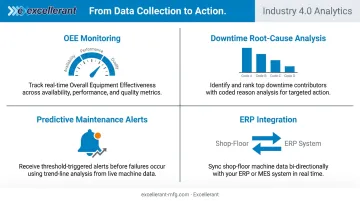
Once data flows reliably, the focus shifts from collection to action. This phase involves:
- OEE monitoring — tracking availability, performance, and quality in real time by machine, shift, and job
- Downtime root-cause analysis — using operator-entered reason codes and automated alarm tracking to identify patterns, not just incidents
- Predictive maintenance alerts — identifying performance drift before failure
- ERP integration — pushing actual production hours, part counts, and scrap quantities to your ERP automatically, eliminating manual labor tickets and data lag
Excellerant's platform captures downtime reasons via a one-tap operator interface, tracks machine-status timelines, and integrates two-way with systems including Epicor, JobBoss, SAP, and Global Shop Solutions.
"The accuracy of information that's coming into our ERP system is exponentially better than what it was before." — Dan Villemaire, C&M Machine Products
Step 6: Scale Across the Facility and Continuously Improve
With a validated pilot in hand, expand using the same structured approach: one area at a time, measuring before-and-after at each stage. Evaluate readiness to scale by asking:
- Have we resolved all integration issues from the pilot?
- Are operators using the system consistently and correctly?
- Are the metrics from the pilot replicable in the next area?
At full deployment, continuous improvement compounds on itself. Real-time data surfaces problems faster than any manual reporting cycle, scheduling systems can adjust dynamically to machine status, and performance trends become visible over weeks, months, and years.
Key Factors That Determine Implementation Success
Legacy Machine Compatibility
Many shops run machines from multiple eras and vendors. The ability to connect legacy equipment without replacing it determines whether implementation is affordable and fast. Protocol-agnostic solutions that support RS-232, serial, and proprietary controls alongside modern ethernet-connected CNCs remove this barrier for most facilities.
Data Quality
If machine data is incomplete, incorrectly tagged, or manually entered at the end of a shift, dashboards and analytics produce misleading conclusions. Automated, direct-from-machine data collection is the only way to produce reliable insights.
Leadership and Change Management
McKinsey research indicates that large-scale transformation efforts fail roughly 70% of the time. A Gartner survey of 347 technology decision-makers found that poor leadership (54%) and entrenched cultural mindset (51%) were the two most common factors in failed organizational change.
Technology deployments stall when adoption fails — not when the software does. Involve shop floor operators from day one by giving them a genuine role in shaping how the system gets used:
- Include operators in workflow design decisions, not just training sessions
- Tie dashboard actions to their daily routines so insights get acted on
- Make accurate data entry something they understand and own, not just a mandate
Their buy-in directly determines whether data collection is reliable and whether the system drives real change.
Focused Scope
Trying to implement robotics, digital twins, AI analytics, and full ERP integration simultaneously leads to stalled projects and budget overruns. A phased scope with clear milestones prevents this. Start with connectivity and OEE visibility. Add layers once the foundation is solid.
ROI Measurement Discipline
Define specific KPIs in Step 2 and measure them at every phase. Implementations that don't track before-and-after metrics lose organizational support over time. The numbers — downtime reduction, OEE improvement, scrap rates, ERP accuracy — are what justify continued investment and expansion.
Common Mistakes in Industry 4.0 Adoption
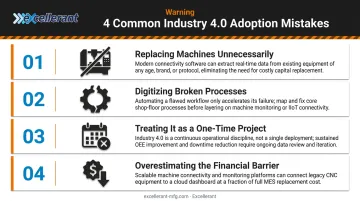
Replacing machines that don't need replacing. Most factories can connect existing equipment with the right connectivity layer. Replacing a functional CNC solely to gain network capability is rarely necessary — and almost never cost-effective.
Digitizing a broken process. Automating an inefficient workflow doesn't fix it — it locks in waste at higher speed. Process review should happen before or alongside digitalization. If your job routing takes five steps it shouldn't, digitizing those five steps makes them faster and harder to change.
Treating it as a one-time project. Industry 4.0 is not a deployment with an end date. It's an ongoing operational capability. Facilities that frame it as a rollout milestone stop improving the moment that milestone is reached.
Overestimating the financial barrier. Modern IIoT platforms built for small and mid-size manufacturers have changed the cost equation significantly. ITIF's 2024 research identifies accelerating digital adoption among U.S. small and mid-size manufacturers as a direct path to improved productivity and competitiveness. The obstacle is more often organizational resistance than budget.
Frequently Asked Questions
What is Industry 4.0 in manufacturing?
Industry 4.0 in manufacturing refers to the integration of IIoT, real-time data collection, automation, and analytics into production operations. The result is a connected shop floor where machines, people, and systems share data in real time — enabling faster, more accurate decisions.
What are the typical phases in an Industry 4.0 roadmap?
The core phases are: digital maturity assessment, goal-setting and business case development, machine connectivity and data collection, pilot deployment, data analysis and action, and phased facility-wide scale-up. Each phase builds on the last.
What are the key Industry 4.0 technologies used in manufacturing?
Core technologies include IIoT machine connectivity, cloud computing, AI-driven analytics, digital twins, robotics, and cybersecurity frameworks. Primary applications include predictive maintenance, OEE monitoring, quality control automation, and supply chain visibility.
Can legacy CNC machines be connected in an Industry 4.0 environment?
Yes. Legacy machines are typically connected using IoT gateway devices, retrofitted sensors, or protocol-agnostic DNC solutions via RS-232 or serial communications — no machine modifications required. Most established machine shops have more connectable equipment than they realize.
How long does Industry 4.0 implementation take for a machine shop?
A focused pilot in a single production cell can deliver measurable results within weeks. Full facility rollout typically spans months using a phased approach. Timeline depends primarily on shop size, equipment mix, and scope of ERP integration.
What is the biggest reason Industry 4.0 implementations fail?
Implementation failures almost always trace back to the adoption process, not the technology. The most common causes are:
- No clearly defined goals or ROI metrics before starting
- Skipping the pilot phase and going straight to full deployment
- Automating broken processes without fixing them first
- Insufficient leadership involvement and operator training