Introduction
Manufacturing in 2026 looks nothing like it did five years ago. Smart manufacturing — using data, connectivity, and intelligent systems to optimize how factories operate — has moved from pilot projects to production reality. Industry 4.0, built on IIoT, AI, and cyber-physical systems, is now the operating standard for competitive shops.
The pressure is real. Manufacturers are dealing with persistent labor shortages, tariff-driven supply chain disruption, and customers in aerospace, defense, and medical devices demanding digital traceability that can't be faked.
According to Deloitte's 2025 Smart Manufacturing Survey, 92% of manufacturers view smart manufacturing as the primary driver of competitiveness over the next three years.
This article breaks down the five forces reshaping the shop floor in 2026 — what's driving each one, and what it means for manufacturers at every stage of the journey.
Key Takeaways
- 92% of manufacturers identify smart manufacturing as their top competitiveness driver, yet fewer than 1 in 5 have moved beyond pilot programs
- AI is moving from analysis to autonomous action, adjusting workflows in real time without human prompts
- IIoT connectivity — legacy machines included — is now a baseline requirement for data-driven manufacturing
- Manufacturing is the most targeted sector for cyberattacks, making cybersecurity a shop-floor responsibility as much as an IT one
- Skilled workers remain essential; the future is human-machine collaboration, not replacement
AI-Powered Operations and Agentic Manufacturing
From Pilot to Production
AI in manufacturing has crossed a threshold. For years, manufacturers ran pilot programs and proofs of concept. In 2026, those pilots are becoming production systems.
Deloitte reports that 29% of manufacturers currently use AI/ML at the facility or network level, with another 23% actively piloting. Generative AI is deployed by 24%, with 38% in pilot. Rockwell Automation's State of Smart Manufacturing report puts 34% of operations as currently augmented by AI, projected to reach 54% by 2030.
The gap worth watching: McKinsey found that 93% of manufacturing COOs plan to increase digital and AI investment over the next five years, but only 2% report AI fully embedded across all operations. There's enormous room between intent and execution.
What Agentic AI Actually Means on the Floor
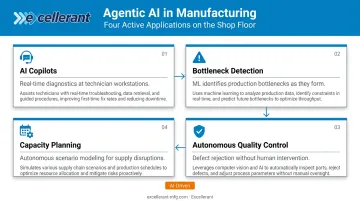
Agentic AI is the meaningful shift. Unlike traditional AI tools that analyze data and surface recommendations, agentic systems take action — adjusting production workflows, flagging supplier risks, generating shift handover reports, and rescheduling jobs — without waiting for a human prompt.
Practical 2026 examples include:
- AI copilots embedded in technician workstations that answer diagnostics questions in real time
- Machine learning algorithms detecting production bottlenecks as they form, not after the shift ends
- AI-driven quality control that rejects defective parts without human intervention
- Autonomous capacity planning and scenario modeling for supply disruptions
The Data Foundation Requirement
None of this works without clean, real-time machine data. AI systems are only as good as what feeds them. A shop still running on manual data entry or next-day reports can't support agentic AI.
This is where connectivity becomes the prerequisite, not a nice-to-have. Excellerant's platform builds this foundation by feeding sensor and machine data into predictive models and a rule engine that surfaces issues before they cause downtime. That real-time data layer is what makes AI-driven decision support actionable on the floor.
IIoT and Real-Time Machine Connectivity
The Digital Thread
IIoT in 2026 has moved beyond tracking individual machines. The concept gaining traction is the digital thread — continuous data flow from machines across the production ecosystem, linking shop floor output directly to front-office decisions.
MarketsandMarkets projects the smart manufacturing market at $380.21 billion in 2026, growing to $995.67 billion by 2032 — a 17.4% CAGR that reflects how seriously capital is chasing this space. Deloitte puts IIoT adoption at 46% of manufacturers at the facility or network level.
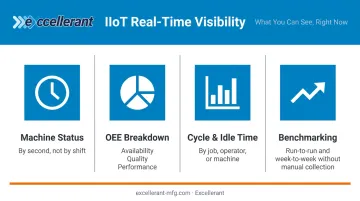
High-precision sensors, edge computing, and real-time analytics are giving operators visibility they simply never had before:
- Machine status by second, not by shift
- OEE broken into availability, quality, and performance components
- Cycle times and idle time by job, operator, or machine
- Run-to-run and week-to-week benchmarking without manual data collection
Solving the Legacy Machine Problem
now runs on more than 250,000 devices across 50+ countries — a sign of how far the standardization story has come.
Why Real-Time Visibility Changes Behavior
When operators see machine status, OEE, and job progress live on the floor rather than in a next-morning report, behavior shifts. Micro-stops become visible. Idle time has a name. Downtime gets categorized at the machine rather than estimated in a meeting.
Rory Miller at McMellon Bros. put it simply after implementing Excellerant: "I can pull it up at any time and find out what's happening with a customer's parts. If we're not on pace, we can fix it." The ability to catch a problem mid-shift — rather than after the job ships late — is where real-time data pays for itself.
Predictive Maintenance and the Push for Zero Downtime
Why Downtime Costs More Than Ever
Unplanned downtime is more costly than ever. Siemens' 2024 True Cost of Downtime report found that automotive downtime costs hit $2.3 million per hour at major plants — roughly 2x 2019 levels. For SMEs, downtime can reach $150,000 per hour. Deloitte notes that poor maintenance strategies can reduce asset productive capacity by 5% to 20%.
Predictive maintenance addresses this by using sensor data — vibration patterns, temperature, current draw, spindle load — to detect early signs of machine degradation before failure occurs. The goal is scheduling maintenance at a convenient time, not scrambling after a breakdown that kills a production run.
The Move to Prescriptive Maintenance
In 2026, the more significant shift is from predictive to prescriptive maintenance — AI that doesn't just alert you that something is wrong, but recommends the exact corrective action, automatically schedules the repair, and can trigger parts orders.
This is where real-time machine data becomes the foundation. Excellerant tracks changes in frequency, amplitude, and bearing wear through a rule engine that flags issues before they escalate. When a problem is detected, immediate alerts reach maintenance teams through the mobile app, and machine data can be shared instantly with remote service providers to cut diagnosis time.
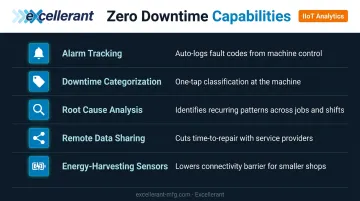
Key capabilities that support the zero-downtime goal:
- Automatic machine-alarm-state tracking that logs fault codes from the control
- One-tap downtime categorization at the machine (tooling, personnel, material, mechanical)
- Root-cause analysis tools that identify recurring patterns across jobs and shifts
- Remote data sharing with service providers to cut time-to-repair
- Self-powered and energy-harvesting sensors that lower the connectivity barrier for smaller shops
Cybersecurity as a Smart Manufacturing Imperative
Manufacturing Is the Primary Target
Every new machine connection and supply chain integration expands the attack surface. The numbers are stark: Dragos reports tracking 119 ransomware groups targeting industrial organizations in 2025, up from 80 in 2024, with manufacturing accounting for more than two-thirds of victims. Fortinet's 2025 OT report found manufacturing was the most targeted sector, representing 17% of targeted incidents.
This isn't a large-enterprise problem. Any connected shop floor is a target.
What Manufacturers Must Do in 2026
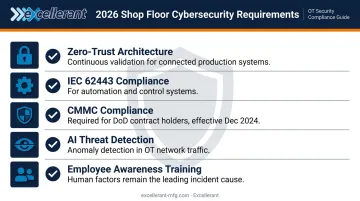
The cybersecurity posture required for a connected shop floor in 2026 includes:
- Zero-trust architecture for connected production systems — no implicit trust, continuous validation based on identity and context (CISA has published OT-specific zero trust guidance)
- IEC 62443 compliance for industrial automation and control systems, particularly for suppliers in aerospace and defense
- CMMC compliance for any shop handling DoD contracts — the CMMC Program final rule became effective December 16, 2024
- AI-powered threat detection that can identify anomalies in OT network traffic
- Employee awareness training — most incidents still involve human factors
For defense and aerospace suppliers, these requirements are contractual obligations, not optional best practices. Excellerant's platform is built specifically for shops navigating CMMC 2.0 and 3.0 requirements. Key compliance features include:
- NIST 800-171 control support across the platform
- Protection of Controlled Unclassified Information within CNC program files
- On-premise deployment options for sensitive environments
- Per-machine event logging for audit trail documentation
- Active Directory integration for role-based access control
Workforce Evolution: Humans and Machines, Better Together
The Skills Gap Is Real and Growing
The talent challenge in manufacturing is structural. The Manufacturing Institute and Deloitte project manufacturers may need as many as 3.8 million additional employees between 2024 and 2033, with 1.9 million jobs potentially unfilled if the talent gap isn't addressed.
Smart manufacturing doesn't solve this by replacing workers. Industry 5.0, the framework now gaining traction from the European Commission, takes a human-centric position: augmenting worker capability rather than eliminating roles. Cobots take on repetitive and hazardous tasks while skilled workers focus on judgment, problem-solving, and oversight.
The IFR reported 542,000 industrial robots installed worldwide in 2024, the fourth consecutive year above 500,000 units. The US installed 34,200 of those. Automation is accelerating — but Deloitte notes 85% of manufacturing executives believe smart manufacturing initiatives will attract new talent, not just reduce headcount.
What Workforce Evolution Looks Like on the Floor
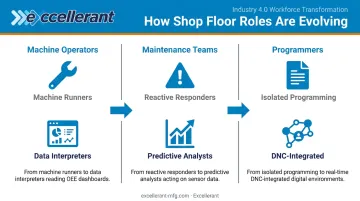
Job roles are changing, not disappearing:
- Machine operators are becoming data interpreters — reading OEE dashboards, categorizing downtime, flagging anomalies
- Maintenance teams are becoming predictive analysts — acting on sensor trends rather than responding to breakdowns
- Programmers are working in integrated digital environments where DNC software connects them in real time to what's running on the floor
Manufacturers are investing in AR/VR for training, using AI to capture tacit knowledge from retiring workers, and building learning cultures that treat technology adoption as an ongoing skill rather than a one-time implementation.
That shift toward data-literate operators is where shop floor interface design matters. Excellerant's Shop Floor Interface gives operators a touch-accessible way to report machine status and communicate job progress directly to the front office — no paperwork, no separate training cycle required.
What's Driving These Smart Manufacturing Trends in 2026
Three forces are converging in 2026 — and for the first time, all three are pushing in the same direction:
The cost of entry has dropped sharply. AI, edge computing, and sensor hardware are significantly more affordable than five years ago. What once required enterprise-scale budgets is now plug-and-play for SMEs. Standards like MTConnect — backed by more than 400 companies and research organizations — deliver interoperability that previously required custom integration work.
Margins are under real pressure. NAM's Q2 2025 Manufacturers' Outlook Survey found 77% of manufacturers named trade uncertainty as their top business concern, with 89% reporting that 2025 tariffs increased the cost of doing business. Deloitte's 2026 Manufacturing Industry Outlook projects input costs rising 5.4% over the next year. At those margins, operational efficiency stops being aspirational — it's survival.
Regulatory requirements are tightening at the same time. FDA's Quality Management System Regulation final rule (effective February 2, 2026) aligns U.S. medical device manufacturers with ISO 13485. CMMC is now contractually active for DoD suppliers. Manufacturers in aerospace, defense, and medical device supply chains who can't provide real-time production data, documented revision control, and auditable quality records risk losing contracts — full stop.
How These Trends Are Reshaping Manufacturing
Operational Impact
Connected shop floors are changing how production is managed. Real-time machine data enables faster decision-making, flags unplanned downtime before it compounds, and eliminates the lag between what's happening on the floor and what the front office sees.
Excellerant's platform addresses this directly: machine monitoring, DNC software, and a finite dynamic scheduler that reschedules against live machine status rather than static assumptions. Dan Villemaire at C&M Machine Products described the shift: "The accuracy of information coming into our ERP system is exponentially better than what it was before. We have been able to improve the accuracy of our costs and increase our value to our customers."
Business Impact
Those operational gains translate directly to the bottom line. Manufacturers that have adopted foundational IIoT tools report measurable improvements in OEE, capacity utilization, and ERP data accuracy. They're also better positioned to win contracts in high-compliance verticals, where customers increasingly require digital traceability as a condition of doing business:
- Aerospace: revision control and real-time quality data for AS9100 compliance
- Defense: audit trails and access controls aligned with CMMC requirements
- Medical devices: traceable process records supporting FDA and ISO 13485 audits
Workforce Impact
Better data also changes the skills that matter on the floor. New roles around system integration and digital tool management are emerging, and operators who can interpret a real-time OEE dashboard and report downtime causes accurately carry more weight than those who can't. The technology is only part of the equation — shops that see the biggest gains pair it with structured training and clear accountability for how data gets used.
Future Signals for Smart Manufacturing Beyond 2026
The 2026 trends covered above are just the starting point. Three signals worth tracking over the next one to three years:
Physical AI and humanoid robots — Deloitte projects adoption to more than double from 9% in 2025 to 22% within two years. BMW and Mercedes-Benz are already piloting humanoid robots on the production floor. At 81%+, most manufacturing task hours remain human-driven — but that share is shrinking faster than most shops expect.
Digital twins + agentic AI convergence — MarketsandMarkets projects the digital twin market growing from $21.14 billion in 2025 to $149.81 billion by 2030. By that point, Gartner expects closed-loop digital twins to move beyond simulation — actively executing operational changes without human intervention.
Tightening cybersecurity regulation — CMMC is active for DoD suppliers. IEC 62443 is becoming the de facto standard for industrial automation security. Manufacturers in defense, aerospace, and critical infrastructure supply chains should expect compliance requirements to expand, not contract.
For shops already invested in real-time machine data and ERP connectivity, these signals point in one direction: the infrastructure you build today determines how quickly you can adopt what comes next.
Conclusion
Smart manufacturing in 2026 is the new competitive baseline — not a roadmap item.
AI, IIoT, predictive maintenance, cybersecurity, and workforce evolution have all moved from conference presentations to shop floors. Manufacturers who act on foundational connectivity now — real-time machine data, DNC program management, OEE visibility — will be best positioned to layer in advanced AI and automation as those capabilities mature.
The entry point doesn't require a greenfield factory or a six-figure technology budget. Excellerant's recommended first step is DNC connectivity — establishing the network infrastructure and real-time data collection that everything else builds on.
Shops can connect 20-, 30-, and 40-year-old machines alongside new CNCs on one platform, start capturing live production data, and expand incrementally as ROI becomes clear.
Every advanced capability covered in this guide — AI-driven scheduling, predictive maintenance, real-time OEE — runs on the data your machines generate. Build that connection first, and the rest follows.
Frequently Asked Questions
What are the smart manufacturing trends in 2026?
The top trends are AI-driven operations, IIoT machine connectivity, predictive and prescriptive maintenance, manufacturing cybersecurity, and workforce evolution toward human-machine collaboration. Manufacturers are shifting from isolated digital tools to integrated, data-driven production systems — covering both technology adoption and operational strategy.
What is the manufacturing industry outlook for 2026?
The outlook is dual-tracked: significant challenges (trade uncertainty, labor shortages, rising input costs) alongside real opportunity. Deloitte projects input costs rising 5.4%, while smart manufacturing investment, AI-driven efficiency, and reshoring incentives are creating pathways for manufacturers who move decisively on operational improvement.
What is the difference between Industry 4.0 and Industry 5.0?
Industry 4.0 focuses on automation, connectivity, and data — connecting machines and systems to improve efficiency. Industry 5.0 adds a human-centric layer, emphasizing collaboration between skilled workers and intelligent systems rather than replacement, with sustainability and resilience as added priorities.
How can small and mid-size manufacturers adopt Industry 4.0 technologies?
Start with foundational steps: connect existing machines — including legacy equipment — to collect real-time production data. Plug-and-play IIoT solutions now support machines of any age and brand, making entry accessible without replacing equipment. Prioritize machine monitoring and DNC program management first, then layer in analytics and advanced tools before scaling up.
What role does IIoT play in smart manufacturing?
IIoT is the connectivity layer that enables machines to communicate, collect data, and feed real-time insights into maintenance scheduling, production capacity, and quality control decisions. Without it, there's no data foundation for AI or advanced analytics to act on.
How does machine connectivity support predictive maintenance?
Connected machines continuously stream sensor data — vibration, temperature, cycle times, alarm states — into monitoring platforms that detect early warning signs of equipment degradation. Maintenance teams can then schedule repairs proactively, before a breakdown occurs, eliminating unplanned downtime and extending equipment life.