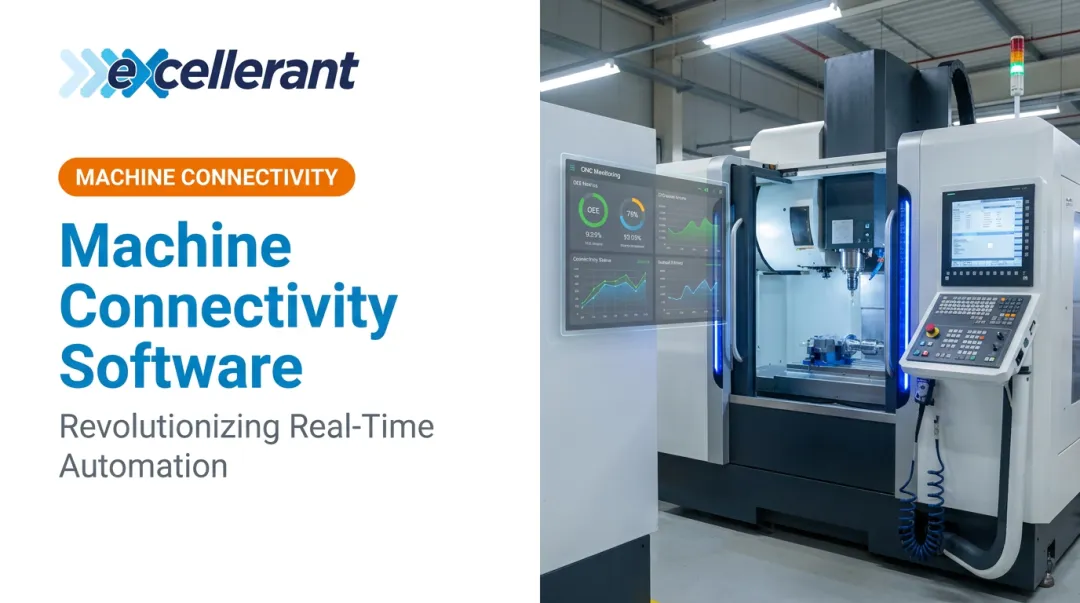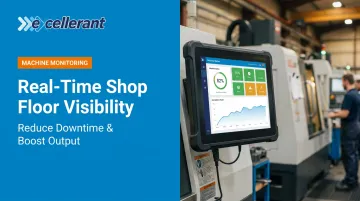
"Real-time visibility" gets discussed plenty in manufacturing circles. Its practical value only shows up, though, when it changes a decision mid-shift — not when it generates a report the next morning that explains what already went wrong.
According to a 2024 Manufacturing Leadership Council survey, 70% of manufacturers still rely on manual data entry, and only 30% use their production data predictively. That gap between data collection and real-time decision-making is exactly where capacity bleeds out.
This article covers what real-time shop floor visibility actually delivers day-to-day, why its advantages are measurable, and what compounds when it's absent.
Key Takeaways
- Real-time shop floor visibility means a live, accurate view of machine states, job progress, and utilization — not end-of-shift summaries or manual logs
- The three biggest payoffs: faster downtime response, reclaimed utilization capacity, and accurate data for front-office decisions
- Most production losses come from short, repeated idle events that never get logged and add up unnoticed across shifts — not catastrophic breakdowns
- Data only helps when it reaches the right person in time to act — next-morning reports support explanation, not course correction
- Mixed-fleet and legacy shops can achieve real-time visibility too, regardless of machine age, brand, or protocol
What Is Real-Time Shop Floor Visibility?
Real-time shop floor visibility is the continuous, live capture and display of machine status, job progress, and production performance — available to operators, supervisors, and managers as it happens, not hours later.
It applies across any environment running CNC machines, machining cells, or mixed-equipment production lines:
- A 10-machine job shop tracking cycle times and idle gaps
- A mid-size contract shop managing multiple active jobs per shift
- A multi-shift aerospace or defense facility monitoring OEE across departments
The scale changes. The principle doesn't.
That said, visibility itself isn't the goal. The goal is faster, better-informed decisions during the shift — catching a stoppage before it compounds, adjusting priorities when a job runs long, or confirming a cell is on pace before the end of the day. A live dashboard no one acts on is just wallpaper.
The Three Key Advantages of Real-Time Shop Floor Visibility
These advantages connect directly to outcomes manufacturers already track: machine utilization, throughput, delivery performance, and data accuracy. They also build on each other — better downtime response creates the foundation for utilization recovery, and both depend on the data accuracy that feeds front-office decisions.
Advantage 1: Faster Detection and Resolution of Unplanned Downtime
When a machine stops unexpectedly, the clock starts immediately. Without live visibility, that stoppage might go unnoticed until a supervisor walks by, an operator mentions it, or the next shift inherits an already-cold problem.
Real-time visibility changes the response entirely. A supervisor sees the machine has been idle for 45 minutes, knows the reason code attached — tooling wait, program issue, material staging — and can route the right person while there's still time to recover within the shift. The same stoppage discovered the next morning can only be explained, not fixed.
This matters because the cost of downtime isn't just the idle time itself. NIST data attributes $18.1 billion in annual downtime losses and $100.2 billion in lost sales to preventable maintenance issues in U.S. discrete manufacturing — the cascade from a single undetected stoppage touches downstream operations, overtime recovery, and delivery commitments simultaneously.
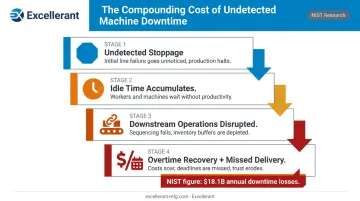
Excellerant's platform handles this with an instant incident notification system that alerts the appropriate person when a machine stops, combined with a one-tap situation picker that lets operators categorize the reason — personnel, material, tooling, or machine malfunction — right at the machine. That reason code determines who gets the alert and what the expected response is.
KPIs most directly impacted:
- Machine uptime percentage
- Mean time to repair (MTTR)
- On-time delivery rate
- Overtime hours per period
When this matters most: Multi-shift operations carry the highest exposure. Shift handoffs are where ownership goes fuzzy, and a stoppage that starts on second shift can go unresolved for hours without live visibility. High-mix/low-volume shops face equal risk — any single machine down directly threatens a specific customer job.
Advantage 2: Recovery of Hidden Utilization Capacity
Most shops don't lose their week to a catastrophic breakdown. They lose it to repeated short idle events: material not staged, first-article inspection waiting, a program edit at the control, tooling not prepped. Each one runs 10–30 minutes. None get logged. Collectively, they represent a significant capacity constraint.
MachineMetrics' 2022 connected-CNC dataset reports average CNC utilization of just 25.9%, with most companies running between 17% and 20%. That capacity sits in short, untracked idle events that feel like "normal variance" — until they're measured.
Real-time visibility surfaces these patterns. When machine states are captured continuously with timestamps and reason codes, repeated short stops become visible across shifts and across machines. What felt like noise becomes a quantified, addressable problem.
The business case is direct: recovering hidden capacity from existing machines costs far less than buying new equipment, hiring additional headcount, or funding overtime. But you can only recover what you can first identify.
Aerospace manufacturer Enjet Aero demonstrated this after replacing manual spreadsheets with automated machine monitoring. Their Terre Haute facility increased utilization from 378 hours in April 2021 to 519 hours by July 2022 — a 27% improvement in nine months — and improved capacity and availability by 35%.
A shop that can demonstrate 15–20% more available capacity through better utilization can take on more work without capital expenditure. That improves both revenue and margin simultaneously.
KPIs most directly impacted:
- Overall Equipment Effectiveness (OEE)
- Machine utilization rate
- Cycle time variance
- Capacity available for quoting
When this matters most: High-mix shops running 10–50 machines across multiple shifts, where utilization leakage is distributed across many machines and invisible without a centralized live view. Also critical when a shop is evaluating capital investment — real utilization data either justifies or replaces the need for new equipment.
Advantage 3: Accurate, Real-Time Data for Front-Office Decisions
In most shops, the data reaching schedulers, estimators, and ERP systems is delayed, summarized, or manually entered. Production forecasts, job costing, and delivery commitments are built on approximations rather than current reality.
That gap has direct consequences:
- Overbooking available capacity
- Under-quoting jobs based on outdated cycle times
- Missing delivery windows
- Eroding customer confidence over time
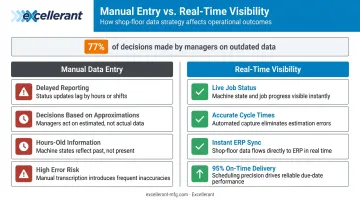
The same MLC survey that found 70% of manufacturers still use manual data entry also found that decision-making responsibility sits 77% with managers — who are making those decisions based on information that's already hours out of date by the time it reaches them.
Real-time shop floor visibility closes that gap. Live machine data flows directly into the systems running the business, so job status, actual cycle times, and completion counts are accurate at any moment — not reconstructed from memory at shift end.
C&M Machine Products, a high-volume precision shop in New Hampshire, saw this play out directly after deploying Excellerant's platform. Dan Villemaire noted: "The accuracy of information that's coming into our ERP system is exponentially better than what it was before. We have been able to improve our accuracy of costs and increase our value to our customers."
The competitive advantage here is concrete: shops that can answer "where is my job right now?" with precision — not approximation — operate differently in markets where delivery reliability is a differentiator. Modern Machine Shop benchmarking shows Top Shops achieve 95% on-time delivery versus 90% for other shops — a gap that sounds small until it determines whether a customer reorders.
KPIs most directly impacted:
- Schedule adherence
- Quote accuracy
- ERP data integrity
- Customer on-time delivery rate
- Time spent on manual reporting per shift
When this matters most: Shops serving aerospace, defense, and medical device customers, where traceability and documentation standards aren't optional. Also highly relevant to any shop that's grown to the point where informal floor-to-office communication no longer scales.
What Happens Without Real-Time Shop Floor Visibility
Without live visibility, shops run on paper logs, whiteboards, and end-of-shift reports. The operational picture looks like this:
- Problems surface after they've already impacted the schedule
- Shift handoffs start with rediscovery instead of execution
- Supervisors spend their time gathering information rather than acting on it
The consequences compound over time in ways that are hard to reverse:
- Reactive management becomes the default. Every day begins with explaining yesterday's losses rather than preventing today's.
- Estimating and scheduling drift from reality. Quoting accurately and committing to delivery dates becomes progressively harder when the data feeding those decisions is disconnected from what's actually happening on the floor.
- Improvement initiatives stall. Without a reliable baseline, there's no way to measure whether a change actually helped — or hurt.
Auburn University's 2024 smart manufacturing study found that 47% of small and mid-sized manufacturers were still only in the awareness or research stage for sensors and IoT. The barriers cited most often: lack of workforce skill sets and no clear business case to justify the move.
The problem intensifies with scale. What works informally in a 5-machine shop breaks down fast across 20–50 machines running multiple shifts — and that's precisely where real-time visibility closes the gap.
How to Get the Most Value from Real-Time Shop Floor Visibility
Visibility delivers value when applied consistently — partial visibility creates blind spots that distort the picture and quietly undermine trust in the data.
A few principles that determine whether visibility translates into operational improvement:
Connectivity has to cover the whole fleet. In mixed-equipment environments (older CNC machines alongside newer controls), a monitoring system that only works with the latest equipment leaves gaps that corrupt the overall picture. Excellerant's universal machine connectivity is built specifically for mixed fleets. Legacy equipment connects via RS-232 serial, BTR, and paper-tape interfaces. Modern CNCs connect via Fanuc FOCAS, HAAS MNET, Mazak Mazatrol, MTConnect, and OPC-UA — all on a single platform, without requiring equipment upgrades.
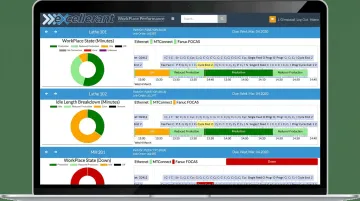
Data needs owners and actions. A machine idle for an hour means nothing if no one is assigned to respond. The platform has to connect alerts to workflows and workflows to people. Excellerant's incident notification routes alerts to the right person based on the reason code attached — maintenance for machine malfunctions, programmers for program issues, material handlers for staging delays.
Shift summaries only work if teams use them. A shift-end summary reviewed together and translated into next-shift priorities is a management habit, not a software feature. The team has to build the practice of acting on it.
Conclusion
Real-time shop floor visibility isn't a reporting upgrade. It changes how the floor operates — managers stop reconstructing what happened and start responding to what's happening. Decisions move from gut feel to evidence, and downtime shifts from something you explain to something you catch early.
Its three advantages — faster downtime response, recovered utilization capacity, and accurate front-office data — compound over time as teams build habits around live information and the data layer becomes more trusted.
Treat visibility as an ongoing operational practice, not a one-time technology installation. The shops that see lasting gains are the ones that review the data consistently, tie findings back to specific machines or processes, and hold performance to a higher standard each quarter.
Frequently Asked Questions
What is real-time shop floor visibility?
Real-time shop floor visibility is the live, continuous capture and display of machine status, job progress, and production performance data, available to operators, supervisors, and managers during the shift. The goal is faster decisions while there's still time to act.
What is shop floor digitalization?
Shop floor digitalization is the broader process of replacing paper-based tracking, manual reporting, and disconnected systems with connected digital tools. Real-time visibility is a core component — alongside digital work orders, automated ERP data entry, and connected scheduling systems.
What are the three phases in shop floor control?
Shop floor control runs in three phases: planning (scheduling jobs and allocating resources), execution (tracking machines and jobs as production runs), and monitoring/feedback (comparing actual versus planned performance and correcting course). Visibility drives that third phase.
What data should be tracked for real-time shop floor visibility?
At minimum, track:
- Machine run, idle, and down states with timestamps
- Reason codes for stoppages
- Job and operation identifiers
- Output counts
- Shift and operator context
That combination turns raw machine activity into information worth acting on, rather than a log nobody reads.
Can real-time shop floor visibility work with older or legacy CNC machines?
Yes. Serial/RS-232 adaptors, PLC intermediary devices, and wireless DNC bridges allow legacy machines to connect alongside modern equipment on a single platform. The key is choosing a solution built specifically for mixed-fleet environments.
What KPIs does real-time shop floor visibility most directly improve?
The most commonly impacted metrics: OEE, machine uptime percentage, on-time delivery rate, mean time to repair, schedule adherence, and the accuracy of ERP and production data. These tend to improve together as data quality and team response habits strengthen over time.