OPC UA was built to solve exactly this. Not just as another protocol, but as a complete communication framework that gives machines, controllers, and enterprise software a shared language — one where data carries meaning, not just numbers.
This guide covers what Industry 4.0 and OPC UA actually mean in practical terms, how they connect, what OPC UA brings to manufacturers, and how shops with decades-old equipment can still participate.
Key Takeaways
- Industry 4.0 connects physical machines with digital systems for real-time, automated decision-making across the entire operation
- OPC UA is the communication standard that makes cross-vendor, cross-platform machine data exchange possible
- RAMI 4.0 explicitly recommends OPC UA as its communication layer, cementing it as the de facto standard for industrial interoperability
- Legacy machines running Modbus, RS-232, or proprietary protocols can join modern IIoT networks via OPC UA gateways — no hardware replacement required
- Bridging legacy shop floors to Industry 4.0 reality requires a platform that translates protocols across machine brands and ages, which is exactly what Excellerant provides
What Is Industry 4.0?
Plattform Industrie 4.0 defines it as "the intelligent networking of machines and processes for industry with the help of information and communication technology." In practice, that means factories where machines share data in real time, decisions get made automatically from live production data, and the shop floor communicates seamlessly with ERP and MES systems.
The Four Capabilities That Define an Industry 4.0 Facility
A facility is genuinely Industry 4.0 capable when it achieves all four of these:
- Real-time machine connectivity — equipment sharing live data across brands and generations
- Automated decision-making — production responses triggered by data, not by someone checking a report
- OT/IT integration — seamless data flow between shop floor systems and enterprise software
- Vendor interoperability — machines from different manufacturers exchanging data without custom integration work for each pairing
Why Manufacturers Are Pursuing This Now
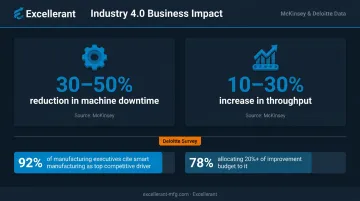
The business case is concrete. According to McKinsey, Industry 4.0 implementations can deliver 30% to 50% reductions in machine downtime and 10% to 30% increases in throughput. A Deloitte 2025 survey of 600 manufacturing executives found that 92% see smart manufacturing as the main driver of competitiveness over the next three years, with 78% allocating more than 20% of their total improvement budget to it.
For machine shops, aerospace manufacturers, defense contractors, and medical device producers, the pressure points are consistent:
- Reduce unplanned downtime before it hits delivery schedules
- Eliminate paper-based reporting and manual data entry
- Improve throughput without adding headcount
- Replace guesswork in production forecasting with real-time data
What Is OPC UA?
OPC UA — Open Platform Communications Unified Architecture — is an industrial communication standard maintained by the OPC Foundation (incorporated in 1996) and formalized as IEC 62541. It's not just a protocol. It's a complete framework for how industrial data is described, structured, secured, and exchanged.
What Makes OPC UA Different from Simpler Protocols
Most protocols move raw data. OPC UA moves meaningful data. A CNC machine running OPC UA doesn't just transmit a number — it transmits a structured, self-describing data point with units, metadata, and relationships that any connected system can interpret without custom configuration.
This capability is called semantic information modeling: OPC UA encodes context alongside values, so receiving systems understand what data means — not just what it says — without custom translation layers.
Platform Independence by Design
OPC UA runs on TCP/IP, meaning it operates on Windows, Linux, embedded controllers, PLCs, cloud platforms, and microcontrollers. Any device with a network connection can participate. This was deliberate: OPC UA's predecessor (OPC Classic, built on Microsoft's DCOM architecture) was locked to Windows, which created serious integration barriers across mixed-OS shop floors.
The Companion Specification Ecosystem
The OPC Foundation has developed more than 150 market-specific OPC UA Companion Specifications — industry-agreed information models for specific equipment types and sectors. These include:
- OPC 40502 (umati) — CNC machine tools, developed jointly with the VDW
- Euromap 77 — injection molding machines
- OPC UA for Robotics — robot controllers
- OPC UA for AutoID/RFID — identification and tracking systems
When a machine implements a Companion Specification, any compliant monitoring system or MES can consume its data without custom mapping work. In practice, that means a new machine can come online and start feeding structured data to your MES or analytics platform the same day — no integrator required.
OPC Classic vs. OPC UA: What Changed and Why It Matters
OPC Classic (also called OPC DA/HDA/A&C) was a meaningful step forward when it launched — it standardized machine data access regardless of manufacturer. But it had a fundamental limitation: it ran on Microsoft's COM/DCOM technology, which meant Windows-only environments and notoriously difficult cross-network communication through firewalls.
The Four Core Improvements OPC UA Introduced
| Feature | OPC Classic | OPC UA |
|---|---|---|
| Platform support | Windows only (COM/DCOM) | Any OS, any hardware (TCP/IP) |
| Security | Added after the fact; often unencrypted | Built in — encryption, certificates, signed messages |
| Data semantics | Raw values only | Structured, self-describing information models |
| Scalability | Limited to local/plant network | Embedded sensors to enterprise cloud |
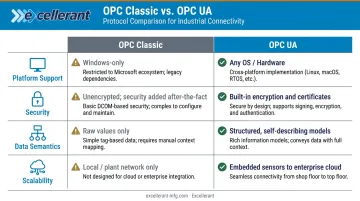
The OPC Foundation's migration guidance notes that OPC Classic historically lacked security features and communications were often unencrypted — a serious liability as shop floors connect to enterprise networks.
What About Existing OPC Classic Infrastructure?
Many facilities still run OPC Classic servers. The transition doesn't require replacing everything at once. Common bridging approaches include:
- OPC UA gateways — translate Classic server data into UA-compatible format without touching existing hardware
- COM/Proxy wrappers — wrap legacy OPC DA servers so they appear as UA endpoints on the network
- Phased replacement — new equipment runs native UA while Classic servers stay online until retired
This lets existing infrastructure stay productive while the shop migrates at its own pace.
Why OPC UA Is the Communication Standard for Industry 4.0
OPC UA and Industry 4.0 are structurally linked — one was built to enable the other.
The RAMI 4.0 Mandate
RAMI 4.0 (Reference Architecture Model for Industrie 4.0), Germany's authoritative blueprint for Industry 4.0 systems, explicitly names OPC UA (IEC 62541) as the recommended technology for the communication layer. RAMI 4.0 formally recommended IEC 62541 OPC UA for the communication layer as early as April 2015, per OPC Foundation documentation.
The ZVEI/Plattform Industrie 4.0 2019 product criteria guideline goes further. For "I4.0 communication," a product's administration shell must be addressable online via TCP/UDP and IP with at least the OPC UA information model.
Products marketed under Industry 4.0 designations (Basic, Ready, or Full) require OPC UA capability, either integrated or through a gateway. This isn't a legal mandate, but it's the classification framework the industry uses.
The practical implication: there is no credible Industry 4.0 architecture without OPC UA at the communication layer.
Solving the OT/IT Integration Problem
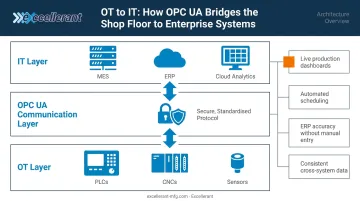
Manufacturing has historically operated with a hard wall between Operational Technology (PLCs, CNCs, sensors) and Information Technology (ERP, MES, cloud analytics). Data collected on the shop floor rarely made it to business systems without manual re-entry , which introduces delays, errors, and zero real-time visibility.
OPC UA's scalable, IP-based architecture closes that gap. Data flows securely from the machine level directly to MES, ERP, or cloud analytics systems — no proprietary middleware required at every layer. In practice, this enables:
- Live production dashboards updated from actual machine data
- Automated scheduling driven by real-time floor status
- ERP accuracy without manual re-entry at shift end
- Consistent data across OT and IT systems simultaneously
OPC UA and MQTT: Complementary, Not Competing
OPC UA and MQTT are not competitors. OPC UA defines the structure and meaning of data. MQTT can serve as an efficient transport for distributing OPC UA-structured payloads to cloud or analytics systems. A practical Industry 4.0 architecture typically uses both : OPC UA as the semantic backbone, MQTT or AMQP for event-driven distribution to cloud systems.
Key OPC UA Capabilities That Enable Smart Manufacturing
Information Modeling and Companion Specifications
OPC UA organizes data into a structured address space of nodes — objects, variables, methods, and events — with defined relationships. Connected systems don't just receive data values; they receive context: what the value means, its units, its source, and how it relates to other data points.
For manufacturers, the practical payoff is in the Companion Specifications. A CNC machine from any vendor implementing the umati specification (OPC 40502) exposes its data in a standardized structure that any compliant MES or monitoring system can consume — no custom integration work per vendor. This is what makes a multi-vendor shop floor manageable.
The OPC Foundation notes the ecosystem now spans more than 150 Companion Specifications covering industries from machine tools and robotics to analyzers and energy management.
Built-In Security Architecture
OPC UA security was designed in from the start, not added later. Every OPC UA session uses:
- Encrypted transport — via SecurityPolicy mechanisms for sign and encrypt modes
- X.509 certificate-based authentication — both client and server verify each other's identity
- Signed messages — preventing tampering in transit
- Built-in auditing — access logging for traceability
Germany's Federal Office for Information Security (BSI) analyzed OPC UA in 2017 and concluded the specification provides a high level of security, finding no systematic errors in the specification itself. A 2022 follow-up found no conceptual security flaws in the updated specification, though it noted that implementation quality varies and that security functions are not always enabled by default.
For manufacturers connecting shop floors to enterprise networks — particularly aerospace, defense, and medical device producers operating under CMMC or ISO 9000 requirements — this matters. OPC UA lets machine builders and system integrators control exactly what data is exposed and to whom.
Client-Server and Publish-Subscribe Communication
OPC UA supports two communication models, and the choice depends on the use case:
- Client-Server — a client requests specific data from a server. Precise, confirmed, well-suited for direct machine-to-system queries where you need a definitive response
- Publish-Subscribe (Pub/Sub) — a server publishes data to a broker for any number of subscribers. Efficient for broadcasting production data to multiple systems simultaneously, including cloud analytics platforms
OPC UA also decouples the information model from the transport layer. Either communication model can use TCP, MQTT, AMQP, or other transport protocols — giving system integrators flexibility without sacrificing the semantic consistency of the data.
Connecting Legacy Machines with OPC UA
Most shop floors aren't greenfield. Production machines stay in service for years — AMT data shows job shops average machine tool ages around seven years, with many individual machines considerably older. The real challenge for Industry 4.0 adoption isn't connecting new machines; it's connecting everything else.
The Brownfield Integration Reality
Legacy equipment communicates via proprietary protocols, RS-232 serial connections, behind-the-tape-reader (BTR) interfaces, and older DNC systems — none of which natively support OPC UA's structured data exchange. Rockwell Automation's 2023 State of Smart Manufacturing Report found that 50% of manufacturers still rely on manual or homegrown systems, with legacy systems consistently identified as a major obstacle to smart manufacturing adoption.
How Gateway Architectures Solve This
An OPC UA gateway connects to legacy equipment using its native protocol, then exposes that data to the broader network as a standards-compliant OPC UA server. The legacy machine doesn't change — only the translation layer that sits between it and the rest of the network.
Aggregating server architectures take this further: consolidating data from multiple legacy devices (each with different native protocols) into a single unified OPC UA address space. From the perspective of any connected MES or ERP system, the data looks consistent and structured regardless of what generated it.
Excellerant's Approach to Mixed-Equipment Environments
That aggregating architecture is exactly what Excellerant built — tracing back to Macdac Engineering in 1991 — through three decades of connecting CNC machines across hundreds of manufacturing plants. The platform was designed for the mixed-equipment reality most shops face.
Supported protocols and connection methods include:
- MTConnect, OPC UA, Fanuc FOCAS, HAAS MNET, Mazak Mazatrol, and Heidenhain TNCremo
- RS-232 serial connections for older equipment that predates network interfaces
- PLC intermediary devices for machines without direct communication ports
- Plug-and-play ethernet or WiFi for modern CNCs
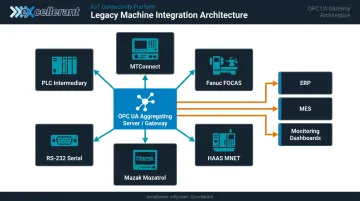
The result: shops can monitor and network 20-, 30-, and 40-year-old machines alongside new CNCs on one platform, with data normalized across protocols and fed in real time to monitoring dashboards, ERP systems (including SAP, Oracle, Epicor, JobBoss, and Global Shop Solutions), and MES platforms.
C&M Machine Products put it directly: "The accuracy of information that's coming into our ERP system is exponentially better than what it was before. We have been able to improve the accuracy of our costs and increase our value to our customers."
Frequently Asked Questions
What is OPC UA in simple terms?
OPC UA is an industrial communication standard that allows machines, sensors, controllers, and software systems to exchange data in a structured, secure, and vendor-neutral way. Unlike simpler protocols that only move raw values, OPC UA defines both how data is transported and what that data means.
What is Industry 4.0 in simple terms?
Industry 4.0 is the fourth industrial revolution, where physical manufacturing systems connect to digital technologies so machines, production lines, and enterprise software share real-time data. The goal is to automate decisions and optimize operations based on live information rather than manual reporting.
How does OPC UA differ from OPC Classic?
OPC Classic was limited to Windows systems due to its COM/DCOM dependency and only moved raw data values. OPC UA is platform-independent (runs on any OS or hardware), built with security by design, and adds semantic information modeling so data carries meaning and context, not just raw numbers.
What is the Industry 4.0 capability model?
It most commonly refers to RAMI 4.0 (Reference Architecture Model for Industrie 4.0), a framework developed in Germany that defines how products and systems must be structured to qualify as Industry 4.0-compliant. OPC UA is explicitly required at the communication layer of this model.
Is OPC UA required for Industry 4.0 compliance?
No single global mandate exists, but the RAMI 4.0 framework and ZVEI classification criteria effectively require OPC UA capability for any product claiming an Industry 4.0 designation. OPC UA is the de facto standard for industrial interoperability, and alternatives are rarely viable in practice.
Can OPC UA connect legacy machines to modern Industry 4.0 systems?
Yes. OPC UA gateways and aggregating servers connect legacy equipment running older protocols (proprietary DNC, RS-232, Modbus) to OPC UA networks without replacing hardware. Complexity varies depending on the equipment involved, but brownfield integration is a well-understood process with established solutions.