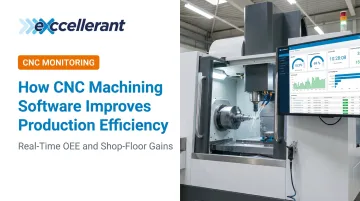
Here's what many shops miss: CNC machines are already precise. The machine isn't usually the problem. The problem is everything around it — how programs get delivered, whether downtime gets logged, whether the front office knows what's actually happening on the floor. That's the software layer, and it's where the efficiency battle is won or lost.
This article breaks down three specific categories of CNC machining software, what each one actually does, and the measurable improvements shops see when they use them consistently.
Key Takeaways
- Monitoring, DNC, and ERP integration are the three software categories with the biggest impact on production efficiency
- Idle machines are the primary productivity drain — real-time monitoring identifies exactly where time is being lost so you can act on it
- NC program errors cause scrap, rework, and machine crashes — DNC software with revision control eliminates the informal handoff methods that create those errors
- 70% of manufacturers still collect data manually, per the Manufacturing Leadership Council — automated integration replaces that gap with real-time accuracy
- Efficiency gains stack: recovering even 30 minutes of daily idle time per machine translates to significant output across a full shift schedule
What Is CNC Machining Software?
"CNC machining software" covers three distinct categories, each operating at a different point in the production process:
| Software Type | Where It Operates | What It Does |
|---|---|---|
| CAM Software | Pre-production (programming phase) | Generates NC programs from part geometry |
| DNC Software | At the machine (program delivery) | Manages distribution, version control, and revision tracking of NC programs |
| Machine Monitoring | During production (real-time) | Captures live machine status, cycle data, event logs, and OEE metrics |
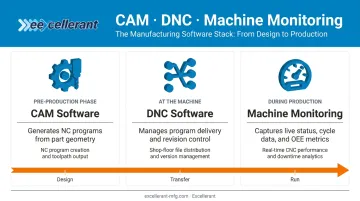
Most shops have CAM covered. The gap is usually in DNC and monitoring — the two layers that govern what actually reaches the spindle and whether anyone knows what the machine is doing minute-to-minute.
Together, DNC and monitoring form the operational control layer that shifts shops from reactive firefighting to consistent, data-driven production management.
Key Advantages of CNC Machining Software
The advantages below tie directly to metrics shop managers already track: OEE, cycle time, scrap rate, and utilization. None of these are theoretical.
Real-Time Machine Monitoring Reduces Unplanned Downtime
Machine monitoring software provides continuous visibility into every CNC on the floor (running, idle, in alarm, waiting for a program) without requiring anyone to physically check. The software connects to each machine, collects status data in real time, and surfaces it in dashboards that operators and managers can act on immediately.
Critically, it also logs why machines stop. Operators use a one-tap interface to categorize stoppages (material shortage, tooling issue, personnel gap, machine fault), separating planned interruptions from unplanned ones. That distinction drives targeted corrective action — you can only address what's been categorized and tracked.
The production impact:
Idle machines are pure waste. When a machine stops unexpectedly, you're not just losing output : you're losing the labor hours assigned to that job, delaying downstream operations, and potentially missing a delivery commitment. The damage compounds across every hour the machine sits.
The impact is measurable in real shops. LeClaire Manufacturing, a precision CNC component shop, increased vertical machining utilization by 38 percentage points and horizontal machining utilization by 19 percentage points over two years after deploying machine monitoring. The same data helped them tighten downtime notification alarms from 45 minutes to 10 minutes, catching problems three times faster than before.
For context on the broader problem: OEE.com notes that world-class OEE is 85%, while many manufacturing companies operate closer to 60%. That 25-point gap represents the improvement opportunity monitoring software helps close.

KPIs directly impacted:
- OEE (Availability × Performance × Quality)
- Machine utilization rate
- Unplanned downtime hours per shift
- Pieces produced per shift
- Mean time between failures (MTBF)
This matters most in multi-machine, multi-shift shops where manual supervision isn't feasible, and in aerospace, defense, or medical environments where delivery reliability isn't negotiable. Excellerant's real-time machine data collection platform covers exactly this use case, with universal connectivity across any brand or protocol, including legacy equipment.
Optimized NC Program Management Eliminates Costly Programming Errors
DNC (Direct Numerical Control) software manages the entire lifecycle of NC programs (storage, distribution, version control, and revision tracking), replacing USB drives, shared folders, and verbal handoffs with a controlled, auditable process.
Programs live in a centralized server. When an operator needs a program, they request it from that server rather than a coworker's USB stick or a folder that may not be current. Only the current, approved revision transmits to the machine. A one-click revision compare shows programmers exactly what changed between versions before anything runs.
What bad programs actually cost:
Modern Machine Shop identifies three categories of CNC program failure: formatting mistakes (including confusing the letter O with zero), process mistakes, and setup errors involving tool length compensation or work coordinate offsets. Many of these errors don't stop the program — they produce scrap or crash the machine outright.
The real cost isn't the error itself. It's what that error produces:
- A scrapped aerospace component worth thousands of dollars in material and machine time
- A rework loop that ties up the machine and delays the next job
- A customer delivery that misses because parts didn't pass first article
- In regulated industries, a compliance finding if the wrong revision ran and wasn't documented
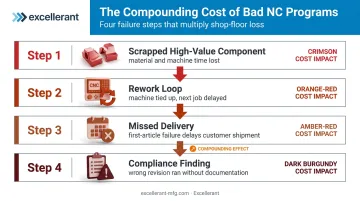
Shops running high-value materials (titanium, Inconel, medical-grade stainless) absorb that cost once and start looking for the software that would have prevented it.
Excellerant's DNC software adds an optional Rev-Lock-Load feature that limits each machine to a single program request, requiring the program to be returned to the server before a new one is accessible. For shops with ISO 9001 or CMMC compliance requirements, this isn't a nice-to-have : it's the mechanism that makes audit traceability possible.
KPIs directly impacted:
- Scrap rate and rework percentage
- First-article approval time
- Program change cycle time
- Audit traceability compliance
- Setup time per job
This matters most in high-mix environments where programs change frequently, regulated industries where traceability is a compliance requirement, and multi-shift shops where program handoffs between operators introduce human error risk.
Shop Floor Data Integration Enables Confident Production Forecasting
CNC machining software that integrates machine-level data with ERP systems transforms raw production events into usable business intelligence. Cycle counts, actual cycle times, job completion status, and downtime events are captured automatically at the machine and flow into production planning and ERP systems.
This replaces manual labor tickets, paper travelers, and end-of-shift reports. Front-office systems reflect what's actually happening on the floor, not what someone manually entered hours after the fact.
Where the gap between floor and front office hurts:
When floor data doesn't reach ERP systems accurately or in real time, the downstream damage compounds quickly:
- Quotes go out based on theoretical cycle times, not actual performance
- Delivery windows are set against capacity that doesn't reflect real utilization
- Job costs come in wrong because actual hours weren't captured
Automated integration closes that gap. When Excellerant customer C&M Machine Products deployed the platform, their data accuracy shifted dramatically . As Dan Villemaire put it: "The accuracy of information that's coming into our ERP system is exponentially better than what it was before. We have been able to improve the accuracy of our costs and increase our value to our customers."
The platform supports bi-directional integration with Epicor, JobBoss, Global Shop Solutions, SAP, and Oracle, pushing real-time part counts, conforming/nonconforming quantities, and actual hours while pulling job and work-order data back to the floor.
KPIs directly impacted:
- On-time delivery rate
- Job costing accuracy
- ERP data integrity
- Schedule adherence
- Forecast vs. actual production variance
This matters most in shops running multiple concurrent jobs and high-mix environments where quotes, delivery dates, and capacity planning depend on production data that's accurate and current.
What Happens When CNC Machining Software Is Missing or Ignored
Shops that rely on manual observation, paper travelers, and USB transfers don't just miss efficiency gains. They accumulate compounding losses that grow harder to reverse as operations scale.
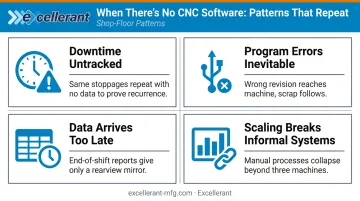
The four patterns that repeat:
Downtime goes untracked and unfixed. Operators know a machine stopped, but without logged data, the same stoppage reasons repeat across weeks — because no one can prove they're recurring.
Program errors become inevitable. Without revision control, running the wrong NC program is a matter of when, not if — and in high-value materials, one scrapped part can cost more than the software that would have prevented it.
Production data arrives too late to act on. End-of-shift spreadsheets give managers a rearview mirror: by the time a problem surfaces in manually collected data, the shift is already over.
Scaling breaks informal systems. Manual processes that work for a three-machine shop become unmanageable at ten machines across two shifts, and inefficiencies that were once tolerable start threatening competitiveness.
How to Get the Most Value from CNC Machining Software
Software delivers lasting gains only when applied consistently. Monitoring one machine while leaving others unconnected creates blind spots that undermine the value of the data you do collect. Full floor connectivity is the foundation — not an eventual goal.
Three operational habits that separate shops that improve from shops that just spend:
- Review downtime patterns weekly — recurring alarm codes, idle windows by shift, and machines waiting on the same resource only reveal themselves through consistent review, not crisis response.
- Feed actual cycle times from the machine into scheduling decisions; measured data is more reliable than estimated standards and stops you from making commitments based on assumptions.
- Connect legacy equipment now rather than waiting on capital upgrades — Excellerant's platform supports any brand and protocol, including RS-232 serial for older machines, so floor-wide visibility doesn't depend on replacing hardware.
Shops that build these habits into daily operations — not just at go-live — are the ones that see measurable, sustained improvements in throughput and scheduling accuracy.
Conclusion
The value of CNC machining software shows up in what it makes visible: machine status, program integrity, and production data. Shop managers who can see these in real time stop reacting and start managing.
Every downtime event identified and addressed reduces the likelihood of the next one. Prevented program errors protect material and machine time. Accurate data flowing into ERP removes guesswork from scheduling. The efficiency gains compound across every subsequent shift, every job, every customer commitment.
The machines are already capable. Software connects that capability to the decisions that determine whether a shop hits its numbers — or explains why it didn't.
Frequently Asked Questions
How to improve CNC efficiency?
CNC efficiency improves through real-time machine monitoring (to identify and eliminate idle time), optimized NC program management (to prevent errors and reduce setup time), and automated production data integration. Software tools are the most scalable way to achieve and sustain these improvements across an entire shop floor.
How does CNC technology improve precision in manufacturing?
CNC machines execute pre-programmed instructions with tight tolerances, but precision failures most often trace back to human error, not the machine itself. DNC software with revision control ensures the right program revision always reaches the right machine, removing the most common source of precision failures in practice.
What is DNC software and how does it improve CNC operations?
DNC software manages the central storage and controlled delivery of NC programs to CNC machines, replacing error-prone methods like USB transfers and shared folders. It ensures only approved, current revisions reach the spindle and provides a complete audit trail for traceability and compliance requirements.
How does machine monitoring software reduce downtime in CNC shops?
Machine monitoring logs every machine state (running, idle, in alarm, waiting) in real time so operators can respond to stoppages immediately. The logged data also reveals recurring downtime patterns, enabling root-cause fixes rather than repeated reactions.
Can CNC machining software work with older legacy machines?
Yes. Capable platforms like Excellerant connect to any brand and protocol (including legacy machines without native networking) using serial communications, RS-232 adapters, and PLC intermediary devices. Shops don't need to replace equipment to gain software-level monitoring and program management.
What KPIs should I track to measure CNC production efficiency?
The most actionable metrics are OEE, machine utilization rate, unplanned downtime hours, scrap and rework percentage, on-time delivery rate, and actual vs. estimated cycle time. CNC machining software collects most of these directly from the machine, eliminating manual entry entirely.