Introduction
Most manufacturers shopping for OEE software focus on the wrong number. The license fee looks manageable. What doesn't show up in the initial quote is the integration labor, the hardware retrofits on older machines, the months of IT involvement, and the slow crawl toward first actionable insight.
Manufacturers choose between two distinct approaches to OEE tracking. Legacy MES OEE is embedded inside a broader enterprise platform — powerful, deeply integrated, and expensive to change. Plug-and-play OEE connects directly to machines through sensors or wireless adapters, goes live in weeks, and requires minimal IT involvement.
The real deciding factors are how fast you need visibility, how much implementation risk your operation can absorb, and whether your budget can sustain a multi-year rollout before seeing results.
This article breaks down the real cost difference — upfront capital, integration labor, ongoing fees, and the often-overlooked cost of delayed ROI — so you can make the right call for your shop.
Key Takeaways
- Plug-and-play OEE deploys in 4–8 weeks; legacy MES OEE typically takes 6–12 months to produce live data
- Guidewheel's 5-year TCO model puts plug-and-play OEE at $476K vs. $1.08M for legacy MES — for a mid-market plant with 25–50 lines
- Legacy MES license fees represent only 15–25% of actual TCO, per Shoplogix's MES cost guide
- The coexistence model pairs MES for order management with plug-and-play OEE for shop-floor visibility, avoiding rip-and-replace risk
- Mid-market manufacturers and machine shops get faster, lower-risk ROI from plug-and-play OEE than from legacy MES implementations
Plug-and-Play OEE vs. Legacy MES: Quick Comparison
| Factor | Plug-and-Play OEE | Legacy MES OEE |
|---|---|---|
| Upfront Cost | ~$52K | ~$395K |
| Deployment Timeline | 4–8 weeks | 6–12 months |
| Ongoing Annual Cost | ~$85K/year | ~$137K/year |
| 5-Year TCO | ~$476K | ~$1.08M |
| Legacy Machine Support | Native — serial, wireless, no retrofits | Typically requires hardwired retrofits |
| IT Dependency | Minimal — browser-based, single server install | High — integration specialists required |
| Operator Adoption | Fast — tablet-optimized, one-tap inputs | Slow — formal training, change requests |
Figures are illustrative benchmarks based on a mid-market model (200–300 employees, 25–50 production lines, ~70% legacy equipment mix). Actual costs vary by plant size and integration scope.
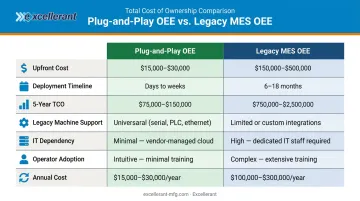
The headline software price is rarely the deciding factor. What separates these two approaches financially is everything that comes after the purchase order: integration labor, sensor or retrofit hardware, change management, and in some cases, a year or more before the system produces usable data. The sections below break down where each dollar goes.
What Is Plug-and-Play OEE Software?
Plug-and-play OEE software connects to machines through lightweight sensors, wireless adapters, or direct Ethernet — without modifying existing machine controls or launching an IT integration project. It tracks the three OEE pillars — Availability, Performance, and Quality — by pulling live signals directly from machine tools and converting them into shift-level dashboards and downtime reports.
The operational impact is immediate. Manual OEE data collection consumes 2–8 hours per week per shift supervisor in spreadsheet reconciliation alone. Plug-and-play tools eliminate that burden and surface recurring stoppages before they compound across shifts.
Where It Fits in the Production Workflow
Plug-and-play OEE operates at the machine and line level, giving shift supervisors same-day root cause data — not week-old MES reports. The feedback loop is tight enough to act on.
Key operational benefits:
- Real-time downtime visibility — machine state captured automatically, no manual entry
- Automated shift dashboards — availability, performance, and quality scores ready at shift start
- Operator-facing inputs — one-tap downtime categorization at the machine (personnel, tooling, material, machine fault)
- Instant notifications — alerts sent to the right person when a machine goes down
The Mixed-Fleet Advantage
The defining capability for most machine shops is universal machine compatibility. Modern plug-and-play tools connect to machines regardless of brand, age, or protocol — and Excellerant's platform, built on over 30 years of CNC networking experience, is a direct example of that range.
The platform supports modern protocols including Fanuc FOCAS, HAAS MNET, Mazak Mazatrol, MTConnect, and OPC-UA. For older equipment, it connects legacy RS-232 serial machines, behind-the-tape-reader CNCs, and controls 20–40 years old via serial communications or PLC intermediary devices. No machine modifications required.
Ideal Use Cases
Plug-and-play OEE fits best in:
- CNC job shops and machine shops with mixed equipment vintages
- Aerospace subcontractors, defense component shops, and medical device manufacturers where uptime is revenue-critical but IT resources are thin
- Manufacturers seeking fast time-to-value without a dedicated OT/IT team
- Operations that need to prove ROI before committing to a larger capital project
What Is Legacy MES OEE?
Legacy MES OEE is an OEE module embedded inside a broader Manufacturing Execution System that also handles order management, scheduling, batch records, quality control, and ERP integration. SAP defines MES as software that monitors, tracks, documents, and controls manufacturing from raw materials to finished products — OEE is one function within that larger suite.
Most legacy MES deployments in mid-market manufacturing were implemented 7–15 years ago. The OEE module reflects the calculation logic and configuration from the original rollout, which means changing even a downtime reason code triggers a formal change request process.
Where Legacy MES OEE Genuinely Excels
Legacy MES OEE makes sense in specific contexts:
- Regulated environments — pharmaceuticals and regulated aerospace where batch records, audit trails, and compliance reporting are non-negotiable
- Large multi-plant enterprises standardizing KPIs across facilities and feeding OEE data directly into ERP cost accounting
- Facilities already running the parent MES for order management and scheduling, where OEE is one more function in an established system
Practical Limitations That Drive Manufacturers to Look Elsewhere
The limitations are real and often surface after go-live:
- Rigid change processes — routine configuration changes (updating downtime codes, modifying dashboards) can cost $10K+ and take weeks
- Poor legacy machine support — older CNCs without Ethernet typically require hardwired counters or proximity switches, driving retrofit costs significantly higher per machine
- Slow iteration cycles — by the time the MES reports a recurring stoppage, the opportunity to act has often passed
Legacy Machine Retrofit Costs
This is where MES implementations frequently exceed budget. Machines without native digital outputs need physical hardware added before the MES can read their status. Industry estimates place full-plant MES retrofit at $200K–$400K for a mixed-fleet plant, compared to $55K–$100K for plug-and-play sensor coverage of the same floor.
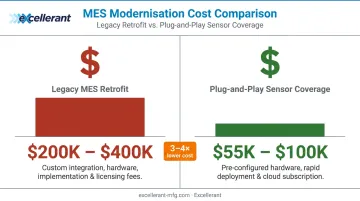
For manufacturers without dedicated IT and OT teams to manage that overhead, plug-and-play OEE tools offer a faster path to the same visibility.
The True Cost of Each: 5-Year TCO Breakdown
License price is the least representative cost driver. According to Shoplogix's MES TCO guide, software licensing represents only 15–25% of total MES TCO — meaning procurement decisions based on license price alone routinely underestimate actual spend by 2–3x.
Six Cost Categories That Drive the Gap
| Cost Category | Plug-and-Play OEE | Legacy MES OEE |
|---|---|---|
| Upfront capital | ~$52K | ~$395K |
| Integration labor | Minimal | 25–40% of TCO ($100K–$500K) |
| Hardware/sensor infrastructure | $55K–$100K full plant | $200K–$400K retrofit |
| Training and change management | Low — browser-based, fast onboarding | High — formal processes, specialist involvement |
| Customization/configuration | Self-service, no change requests | Formal change requests, often $10K+ per change |
| Annual maintenance fees | Per-asset subscription | 15–25% of initial software investment annually |
Shoplogix reports that manufacturing companies typically invest $375K–$1.2M for full MES implementations, with implementation services alone accounting for $100K–$500K and integration development adding another $75K–$350K.
Time-to-Insight: The Cost Nobody Puts in the Quote
Every month between implementation kickoff and first actionable insight is unrealized savings. Plug-and-play OEE typically produces first insights within 4–8 weeks. Legacy MES deployments average 6–12 months to live data — and complex integrations can stretch to 18 months.
That gap matters. A plant running at 60% OEE with genuine improvement opportunity doesn't benefit from a monitoring system that won't report usable data for a year.
5-Year TCO Summary
| Approach | 5-Year TCO | Deployment Timeline |
|---|---|---|
| Manual tracking (Excel) | ~$319K visible cost | Not applicable |
| Legacy MES OEE | ~$1.08M | 6–12 months |
| Plug-and-play OEE | ~$476K | 4–8 weeks |
Source: Guidewheel's 2026 mid-market model (200–300 employees, 25–50 lines). These are illustrative benchmarks — actual costs vary by plant size, integration scope, and vendor.
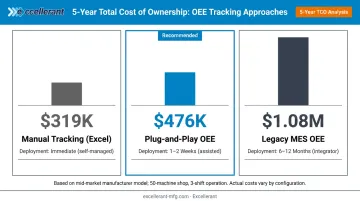
These totals also don't capture per-seat licensing exposure. Excellerant's pricing includes unlimited user access — no per-seat fees — so adding displays, tablets, or team members doesn't trigger additional licensing costs. MES platforms that charge per seat can add meaningful cost as adoption expands across the shop floor.
Choosing the Right Approach for Your Shop
The right choice comes down to three variables: your current IT capacity, your machine fleet's age and mix, and how quickly you need actionable data on the floor.
Choose Plug-and-Play OEE If:
- Your priority is fast deployment and same-week visibility into downtime
- Your shop runs a mix of modern and legacy machines (10–40 years old)
- IT resources are limited and you need minimal ongoing IT involvement
- You want to prove ROI before committing to a larger capital project
- You need per-machine data without a per-seat licensing model
Choose Legacy MES OEE If:
- Your facility already runs the parent MES for order management and scheduling
- You operate in a heavily regulated environment requiring integrated batch records and audit trails
- You have a dedicated OT/IT team and a 12+ month implementation window
- OEE must feed directly into ERP cost accounting without custom middleware
The Coexistence Model: A Practical Middle Path
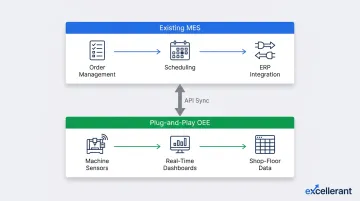
Rip-and-replace is rarely necessary, and for most shops it's the wrong move. The most practical path is to keep the existing MES handling order management and scheduling (where it's stable), then layer plug-and-play OEE alongside it for real-time shop-floor visibility.
Excellerant's platform is designed explicitly for this architecture. Its Open API enables bi-directional data synchronization with major ERP and MES platforms: SAP, Oracle, Epicor, and JobBoss. Real-time machine and operator data pushes into existing systems while job and work-order data pulls back to the shop floor.
Existing MES investments stay intact. The data layer underneath gets modernized.
A Composite Shop Scenario
That architecture plays out clearly in mixed-fleet environments. Consider a mid-size machine shop with 30 CNC machines: current-generation machining centers alongside equipment that's 15+ years old without Ethernet. A full MES OEE implementation would require hardwired retrofits on the legacy machines, months of IT involvement, and a six-figure integration budget before producing a single useful report.
A plug-and-play approach — connecting modern CNCs via Ethernet and legacy machines via serial or wireless adapters — goes live with real-time downtime dashboards in weeks. In deployments like this, a recurring daily stoppage on a legacy machining center frequently surfaces within the first two weeks — invisible in spreadsheet-based tracking because operators categorized it differently shift to shift, with no system aggregating the pattern automatically.
For shops facing exactly this mixed-fleet challenge, Excellerant's universal machine connectivity — built on three decades of hands-on CNC networking across hundreds of manufacturing plants — is a practical starting point for a no-cost connectivity assessment.
Frequently Asked Questions
What is OEE software?
OEE software measures Overall Equipment Effectiveness by tracking three pillars: Availability, Performance, and Quality. It turns raw machine data into efficiency scores. It helps manufacturers identify where production time is lost to downtime, speed losses, or defects, so they can act on the right problem first.
How long does it take to deploy plug-and-play OEE software compared to a legacy MES?
Plug-and-play solutions using wireless sensors or serial adapters typically go live across a full plant in 4–8 weeks. Legacy MES OEE implementations commonly take 6–12 months, sometimes longer, due to integration complexity, hardware retrofitting on older machines, and formal IT change processes.
What hidden costs should manufacturers expect from a legacy MES OEE module?
The biggest surprises include:
- Integration labor: Shoplogix estimates $100K–$500K for MES implementations
- Hardware retrofits for legacy machines not natively supported
- Annual maintenance fees running 15–25% of the initial software investment
- Change request costs for routine updates like modifying downtime reason codes
Can plug-and-play OEE software run alongside an existing MES system?
Yes, and this coexistence model is common. The existing MES continues handling order management and scheduling, while the plug-and-play OEE layer provides real-time shop-floor visibility. No changes to the existing system are required; the two layers operate independently and can sync through API integration.
Is plug-and-play OEE cost-effective for small machine shops?
Plug-and-play OEE is well-suited for smaller shops. Low upfront capital, fast deployment, and per-asset (not per-seat) pricing make it accessible without a large IT team. Sensors typically pay for themselves quickly by surfacing downtime patterns that were previously invisible in spreadsheet-based tracking.
What OEE score should a manufacturer realistically target?
According to LeanProduction, 85% is considered world class for discrete manufacturers, 60% is fairly typical, and 40% is common for operations just starting to track OEE. The most useful benchmark isn't the industry average — it's internal comparison: how one line performs against another, how shifts stack up, and whether this week beat last week.