The good news is that purpose-built and right-sized IoT analytics platforms now exist for small manufacturers. According to IoT Analytics, 54% of small and medium-sized plants still used pen and paper or spreadsheets as their MES in 2024 — which means the competitive advantage from making the switch is still wide open.
This guide covers the five best IoT analytics platforms for small manufacturers in 2026, the selection criteria that actually matter at this scale, and the common mistakes to avoid when evaluating options.
Key Takeaways
- IoT analytics platforms connect shop floor machines to real-time dashboards showing OEE, downtime causes, and production performance
- Enterprise platforms (Siemens, Rockwell, PTC ThingWorx) are over-engineered and over-priced for most small shops
- Key selection criteria: legacy machine connectivity, fast deployment, low IT overhead, and affordable pricing
- Five platforms are compared: from purpose-built shop tools (Excellerant, MachineMetrics) to flexible cloud infrastructure (AWS IoT SiteWise, Litmus Edge, Azure IoT)
- Start with a 90-day pilot on 5–10 critical machines before committing to any platform
What Is IoT Analytics for Small Manufacturing?
IoT analytics in manufacturing means software that collects real-time data from machines, sensors, and controllers on the shop floor, then turns that raw data into actionable insights — OEE scores, cycle times, downtime causes, energy use — that operators and managers can act on during the shift, not hours later.
Why Small Manufacturers Have Different Needs
The requirements for a 15-machine job shop differ fundamentally from those of a 500-machine plant. Small manufacturers typically deal with:
- Mixed equipment ages — a shop might run a brand-new Haas alongside a 30-year-old Fanuc-controlled vertical mill
- No dedicated IT staff — the person evaluating the platform is often also running jobs
- Tight capital budgets — a $200,000 enterprise deployment isn't a conversation worth having
- Speed requirements — deployments measured in days, not months
These constraints rule out most enterprise IoT platforms before the first demo.
Why the SMB Segment Is Driving Platform Innovation
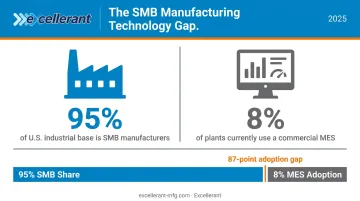
Small and medium-sized manufacturers represent more than 95% of the U.S. industrial base, yet only 8% of plants currently use a commercial MES. The platforms maturing to serve this segment are doing so with SMB-specific pricing, faster deployments, and connectivity that handles legacy machines alongside modern ones.
Best IoT Analytics Platforms for Small Manufacturers in 2026
Platforms were evaluated on five criteria most relevant to small manufacturers: compatibility with legacy and mixed-brand equipment, deployment speed, total cost of ownership, ease of use without dedicated IT, and quality of real-time dashboards and alerting. Each platform below is assessed against these criteria, with honest notes on fit, limitations, and cost.
Excellerant — Best for Small Machine Shops with Legacy CNC Integration
Excellerant's roots go back to 1991 (Macdac Engineering), making it one of the most experienced machine tool networking companies in the industry. Founder John Carpenter developed the world's first wireless DNC connection to a machine tool in 2001, a milestone that predates most of today's IIoT market by over a decade.
The platform is purpose-built for small manufacturing environments. It connects machines of any brand, age, or communication protocol through MTConnect, OPC-UA, Fanuc FOCAS, HAAS MNET, Mazak Mazatrol, and RS-232 serial, including behind-the-tape-reader (BTR) machines and paper-tape controllers.
For shops running 20-, 30-, and 40-year-old CNCs alongside new equipment, this universal connectivity is a genuine differentiator.
What sets Excellerant apart for small shops:
- Connects any machine regardless of brand, age, or protocol — no machine replacement required
- Unlimited client access with no per-user or per-seat licensing fees
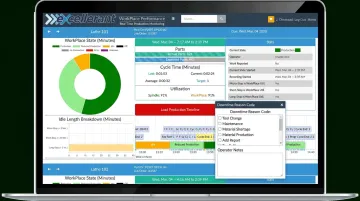
- Real-time OEE calculation with operator-entered downtime reason codes and root-cause dashboards
- Integrated wireless DNC with one-click G-code revision compare (critical for ISO 9000 and CMMC compliance)
- Finite dynamic scheduling that adjusts in real time based on live machine status
- Bi-directional ERP integration with Epicor, JobBoss, Global Shop Solutions, SAP, and Oracle
- MTConnect Standards Committee Voting Member — direct influence on the protocol's development
- USA-based technical support team
| Attribute | Details |
|---|---|
| Key Features | Real-time machine monitoring, OEE analytics, wireless DNC, universal machine connectivity (MTConnect, OPC-UA, Fanuc FOCAS, HAAS MNET, RS-232), production dashboards, ERP/MES integration, finite scheduling |
| Ideal Shop Profile | Small machine shops and job shops with 5–100 CNC machines, mixed-brand or legacy equipment, no dedicated IT team, defense or quality-regulated environments |
| Pricing Model | Contact Excellerant directly; no per-user licensing fees; USA-based support included |
MachineMetrics — Best for Real-Time Shop Floor Production Intelligence
MachineMetrics positions itself as an Intelligent MES and AI-powered machine monitoring platform for discrete manufacturers. It connects directly to CNC machines to stream real-time data to cloud-based dashboards accessible by operators, supervisors, and management simultaneously.
The platform supports a wide range of CNC brands and protocols, including MTConnect, OPC-UA, Fanuc FOCAS, Ethernet/IP, and Modbus, with pre-built connectors that reduce setup time. Its AI-powered Daily Production Dashboard generates automated shift summaries, useful for shops where managers aren't on the floor continuously.
Differentiators worth noting:
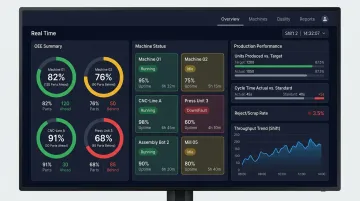
- Real-time OEE and automated downtime categorization
- Predictive maintenance using machine condition thresholds and AI-powered alerts
- ERP integration via open API
- Scales from single-site job shops to multi-facility contract manufacturers
Vendor-published outcomes include a 25–30% OEE increase for a medical device manufacturer and 11,500 hours of unplanned downtime eliminated for another customer. These are MachineMetrics-attributed figures, not independent benchmarks.
| Attribute | Details |
|---|---|
| Key Features | Real-time OEE, machine monitoring, predictive maintenance, Intelligent MES, ERP connectors, AI production summaries |
| Ideal Shop Profile | Contract manufacturers, job shops, and precision machining operations wanting full shop floor visibility with AI capabilities |
| Pricing Model | Subscription-based SaaS; no public dollar tiers — contact vendor for pricing by asset count and feature tier |
AWS IoT SiteWise — Best Pay-As-You-Go IIoT for Budget-Conscious Shops
AWS IoT SiteWise is Amazon's managed industrial IoT service that collects, organizes, and analyzes equipment data using OPC-UA, Modbus TCP, and Ethernet/IP. The pay-as-you-go pricing makes it one of the most accessible entry points for shops that want cloud IoT without a long-term platform contract.
Current pricing (as of mid-2026): The SiteWise Edge Data Collection Pack is free for on-premises data collection. The Data Processing Pack costs $200 per active gateway per month. Cloud messaging runs at $1.00 per million messages, with data processing at $0.50 per million computations.
A small plant deployment typically falls in the range of a few hundred to a few thousand dollars per month depending on machine count and data volume.
Before committing, note these limitations:
- SiteWise Monitor (the built-in dashboard) is no longer available to new customers — plan to use Amazon Managed Grafana or another visualization layer
- More configuration is required compared to purpose-built manufacturing solutions
- Works best for shops with some internal IT capability or an integration partner
| Attribute | Details |
|---|---|
| Key Features | OPC-UA/Modbus/Ethernet-IP connectivity, asset modeling, OEE calculations, AWS ecosystem integration (Lambda, SageMaker, S3) |
| Ideal Shop Profile | Shops already using AWS, or those wanting flexible pay-as-you-go pricing with no contract minimums and some IT capability available |
| Pricing Model | Pay-as-you-go; Edge Data Collection Pack is free; Data Processing Pack at $200/gateway/month |
Litmus Edge — Best for Mixed-Vendor and Legacy Equipment Connectivity
Litmus Edge is an edge-native IIoT platform focused on the hardest problem in small manufacturing IoT: getting data off heterogeneous equipment. With support for 250+ industrial protocols, it handles legacy PLCs, older CNCs, robots, and sensors from multiple vendors and routes that data to any cloud or analytics destination.
For shops where other platforms hit a wall on connectivity, Litmus functions as the data extraction layer that makes everything else possible.
Key differentiators:
- Vendor-neutral architecture with no cloud lock-in
- Routes data to AWS, Azure, Google Cloud, Databricks, and Oracle Cloud
- Connects to CMMS, MES, ERP, and historian environments via API
- Free Developer Edition available for testing pipelines before purchasing
- Foundation plan starts at $1,500/month (publicly listed as of mid-2026)
One practical note: Litmus functions primarily as a connectivity and data-routing layer. Most shops will still need a separate analytics dashboard downstream It doesn't replace a purpose-built manufacturing analytics platform; it feeds one.
| Attribute | Details |
|---|---|
| Key Features | 250+ industrial protocol support, edge-native architecture, cloud-agnostic data routing, containerized edge apps |
| Ideal Shop Profile | Shops with older or mixed-brand machines that other platforms cannot connect to; used as a connectivity layer feeding data to any analytics tool |
| Pricing Model | Foundation plan from $1,500/month; contact vendor for site-based deployment pricing |
Microsoft Azure IoT — Best for Shops Already in the Microsoft Ecosystem
Azure IoT provides IoT Hub for device connectivity, Azure Digital Twins for virtual equipment modeling, Azure IoT Edge for on-premise processing, and Azure IoT Operations for edge data normalization before cloud ingestion. For small manufacturers already running Microsoft 365 or Dynamics 365, this creates a connected operational environment without adding new vendor relationships.
Azure IoT Hub pricing tiers:
- Free tier: 8,000 messages/day
- S1: $25/unit/month — 400,000 messages/day
- S2: $250/unit/month — 6,000,000 messages/day
Power Automate can trigger maintenance work orders automatically when anomalies are detected, which reduces manual follow-through on alerts.
Honest assessment: Azure IoT requires meaningful configuration effort. It's best suited for shops with IT support or a systems integrator. Total costs scale with message volume and connected services, so model your data volumes carefully before committing.
| Attribute | Details |
|---|---|
| Key Features | IoT Hub, Azure Digital Twins, IoT Edge, Azure IoT Operations, Power BI dashboards, Power Automate workflows |
| Ideal Shop Profile | Small manufacturers running Microsoft 365 or Dynamics 365 who want operational data integrated into existing business systems |
| Pricing Model | Pay-as-you-go; free tier for evaluation; S1 from $25/unit/month; costs scale significantly with message volume |
How We Chose the Best IoT Analytics Platforms for Small Manufacturing
These platforms were assessed through the lens of a small manufacturer with 10–100 machines, limited IT staff, a mix of legacy and newer CNC equipment, and an annual budget in the range of $10,000–$30,000 — not a six-figure enterprise contract.
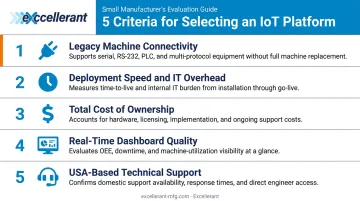
The Five Criteria That Matter at This Scale
- Legacy machine connectivity and protocol breadth — Can it actually talk to the machines on your floor, including the old ones?
- Deployment speed and IT overhead — Can a non-IT person get it running in days, not months?
- Total cost of ownership at small scale — What's the real annual cost including hardware, integration labor, and support?
- Quality and usability of real-time production dashboards — Will operators actually use it, or will it become shelf software?
- USA-based or responsive technical support — At 6 AM when something breaks, you need a human — not a ticket queue.
Each platform that made this list could be evaluated, priced, and running on a real shop floor — not just demoed to a procurement committee.
Why Enterprise Platforms Were Excluded
PTC ThingWorx, Rockwell FactoryTalk, and Siemens Insights Hub were excluded. Not for lack of capability, but because their sales motion, deployment complexity, and enterprise-scale positioning make them a poor fit for shops under 100 machines. Rockwell directs buyers to work with a local sales consultant just to determine software requirements. That process alone puts you weeks into a sales cycle before you've seen a demo — a timeline that doesn't fit a 20-machine job shop's reality.
Conclusion
The right IoT analytics platform for a small manufacturer isn't necessarily the most powerful one. It's the one that connects to your actual machines (including the ones from 1995), deploys without requiring a dedicated IT team, and shows real results in production dashboards within days.
When you're ready to move forward, keep three things in mind:
- Run a 90-day pilot on your 5–10 most critical machines before committing
- Define one clear use case upfront: downtime reduction, OEE improvement, or predictive maintenance
- Evaluate total cost of ownership — integration labor and support, not just the license fee
Excellerant's team brings over 30 years of CNC machine networking experience, connecting machines of every brand and era to real-time data platforms. If you're a small machine shop looking for IIoT solutions that work with your existing equipment (legacy controllers included), reach out to the Excellerant team to discuss your specific machine mix and production goals.
Frequently Asked Questions
How is IoT used in the manufacturing industry?
IoT in manufacturing connects machines, sensors, and production equipment to collect real-time data on performance, uptime, quality, and energy use. This enables predictive maintenance, automated OEE monitoring, and production visibility across the shop floor without manual data entry.
What are the four types of IoT platforms?
The four main categories are connectivity platforms (device and protocol management), cloud platforms (data storage and processing), analytics platforms (generating insights from collected data), and application enablement platforms (building custom IoT applications). Most manufacturing solutions combine multiple layers into one product.
What are the 5 C's of IoT?
The 5 C's framework covers Connection (linking devices to networks), Collection (gathering data from those devices), Computing (processing data at the edge or cloud), Cognition (generating insights through analytics), and Communication (delivering those insights to operators and decision-makers).
Is IoT replaced by AI?
IoT and AI are complementary, not competing technologies. IoT handles data collection infrastructure while AI analyzes that data to generate predictions and recommendations — a distinction a NIST AI commentary draws clearly. In manufacturing, AI-powered analytics layers are increasingly built on top of IoT data streams, not in place of them.
Can small manufacturers connect legacy CNC machines to IoT analytics platforms?
Yes. Several platforms support legacy connectivity through MTConnect, OPC-UA, Modbus, and Fanuc FOCAS. Excellerant connects machines of any brand or age — including RS-232 serial and behind-the-tape-reader controllers — without machine replacement or expensive retrofits.
What is a realistic budget for IoT analytics in a small manufacturing shop?
SMB-targeted platforms typically run $10,000–$30,000 annually for a small shop deployment, versus $100,000+ for enterprise suites. Cloud pay-as-you-go options like AWS IoT SiteWise can start lower for limited deployments. A 2024 study on U.S. manufacturing SMEs found IIoT implementation costs ranging from near $0 to $70,000 depending on scope and equipment complexity.