Introduction
Most shop floors have a costly blind spot. Machines run below capacity, breakdowns arrive without warning, and production decisions get made from yesterday's data — or no data at all. According to Siemens/Senseye's 2024 downtime analysis, unplanned downtime costs the world's 500 largest companies $1.4 trillion annually — roughly 11% of revenues. For manufacturers still relying on manual checks and paper logs, that number is avoidable.
Machine performance monitoring is the continuous process of collecting, storing, and analyzing real-time data from production equipment to track health, utilization, and output. Done right, it gives operations teams the visibility to act on problems before they become stoppages — not after. Here's what this guide covers:
- Key metrics to monitor (OEE, downtime, cycle time, condition indicators)
- Core business benefits with supporting data
- Real-world use cases across manufacturing sectors
- Types of monitoring systems and how they differ
- A practical implementation guide, including common pitfalls
What Is Machine Performance Monitoring?
Machine performance monitoring means your equipment is continuously reporting its own status — not waiting for an operator to notice something is wrong, or for an end-of-shift report to reveal a problem that started hours ago.
Beyond Manual Tracking
Traditional approaches rely on operators manually logging downtime reasons on paper forms, recording cycle counts at shift end, and escalating problems after they've already caused production losses. The Manufacturing Leadership Council reported in 2024 that 70% of manufacturers still collect data manually — and 44% said their data volume had at least doubled in two years. That's a widening gap between what manufacturers need to know and what manual processes can deliver.
Connected monitoring, enabled by IIoT sensors and direct machine interfaces, closes that gap. Understanding what gets captured — and how — is where that gap starts to close in practice.
What Gets Captured
A modern monitoring platform collects:
- Machine status: running, idle, down, or in alarm state
- Cycle times: actual time per operation versus target
- Utilization rates: productive time as a percentage of available time
- Part counts: good parts versus scrap, by job and shift
- Condition data: vibration, temperature, load, and bearing wear from connected sensors
- Operator inputs: downtime reasons, part completions, and nonconformance flags
Platforms like Excellerant pull this data directly from machine controls across any brand or protocol — from modern CNCs connected via ethernet to 40-year-old machines communicating over RS-232 serial — and feed it into a unified dashboard alongside ERP systems.
Key Metrics to Track in Machine Performance Monitoring
Overall Equipment Effectiveness (OEE)
OEE is the standard benchmark for productive machine time. According to OEE.com, the formula is:
OEE = Availability × Performance × Quality
- Availability = Run Time ÷ Planned Production Time
- Performance = (Ideal Cycle Time × Total Count) ÷ Run Time
- Quality = Good Count ÷ Total Count
LeanProduction benchmarks: 85% OEE is world class, 60% is typical, and 40% is common for manufacturers just beginning to track performance. A shop at 60% OEE is losing 40% of its planned production time to avoidable downtime, speed losses, and defects.
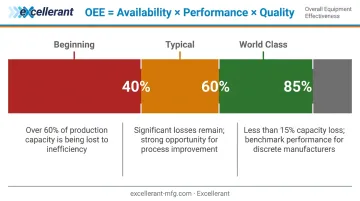
Excellerant calculates OEE continuously, breaking it into all three components by machine, shift, and job — so managers can pinpoint whether a gap is a utilization problem, a speed problem, or a quality problem.
Machine Downtime and Utilization
Not all downtime is equal. Planned downtime (scheduled maintenance, changeovers) is manageable. Unplanned downtime is where the real losses occur.
MachineMetrics' 2022 CNC machining dataset reported average CNC utilization of just 25.9%, with most shops operating between 17–20% and high performers reaching 60%. That gap between typical and high-performing shops represents recoverable capacity — no new equipment required.
Effective monitoring tracks:
- Idle time by machine, shift, and job
- Downtime duration and frequency
- Root-cause categories (personnel, material, tooling, machine malfunction)
Cycle Time and Production Rate
When a machine runs slower than its target cycle time, the loss is invisible without monitoring. OEE's Performance factor captures this: slow cycles and minor stops reduce Performance just as much as hard stoppages.
Excellerant compares actual-to-expected output in real time, surfacing cycle time deviations through two channels:
- Shop Floor Interface — operators see deviations as they happen
- Performance dashboards — managers catch slow shifts before they become missed deliveries
Condition Indicators — Vibration, Temperature, Load, and Torque
Beyond cycle time, physical sensor data reveals equipment health before problems surface. SKF identifies vibration, speed, temperature, and load as critical machine-tool operating parameters that can signal early bearing failures.
Temperature data deserves particular attention. NIST research found that thermal errors account for up to 75% of total geometrical errors in a machined part. Temperature drift doesn't just threaten equipment — it threatens part quality on every cycle it goes unchecked.
Excellerant's platform monitors changes in frequency, amplitude, force intensity, and bearing wear through connected sensors, so operators can catch deteriorating conditions before they cause downtime or scrap.
Core Benefits of Machine Performance Monitoring
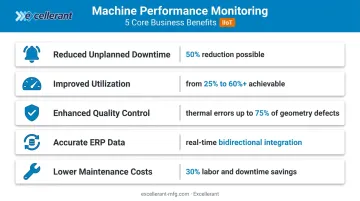
Reduced Unplanned Downtime
Continuous monitoring catches problems early. Abnormal vibration, temperature spikes, and load increases are detectable before they escalate to failure, giving maintenance teams time to intervene rather than scramble.
Siemens/Senseye research indicates predictive maintenance approaches can reduce unplanned downtime by 50% and maintenance costs by 40%. Even modest improvements matter: the same research puts the average large industrial plant's annual downtime loss at $253 million.
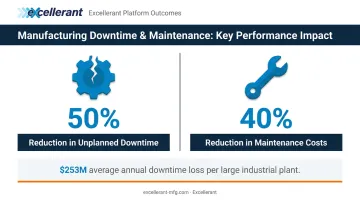
Excellerant's predictive rule engine monitors machine and sensor data 24/7 and pushes instant alerts through its mobile app to the right person — maintenance technician, floor manager, or both — the moment a threshold is crossed.
Improved Machine Utilization and Production Output
Most shops don't need more machines. They need better visibility into the ones they have.
Monitoring exposes the hidden capacity loss that manual tracking misses:
- Idle time between jobs
- Slow cycles that fall below target rate
- Changeover and setup time that exceeds estimates
With utilization data in hand, managers can optimize scheduling, balance workloads across a machine fleet, and make capital purchase decisions based on actual utilization — not gut feel. Excellerant provides machine-utilization reports with run-to-run, week-to-week, and year-to-year comparisons specifically to support those conversations.
Enhanced Quality Control
Machine conditions and part quality are directly linked. Three common failure modes illustrate this:
- Temperature drift in a ball screw causes positioning errors
- Vibration degrades surface finish
- Torque inconsistencies signal tool wear
Monitoring creates a traceable log of machine conditions for every job. When a quality issue surfaces, teams can correlate it to a specific machine, shift, or time window — cutting root-cause analysis from hours to minutes. Excellerant lets operators flag parts as conforming or nonconforming directly at the machine, with that data pushed to ERP in real time alongside the machine conditions recorded at that moment.
Accurate ERP and Production Data
Manual data entry is slow, inconsistent, and error-prone. Monitoring replaces it.
Excellerant integrates bidirectionally with ERP platforms including SAP, Oracle, Epicor, JobBoss, and Global Shop Solutions. Real-time machine and operator data flows in automatically; job and work-order data pulls back to the shop floor. As one Excellerant customer, Dan Villemaire of C&M Machine Products, put it: "The accuracy of information that's coming into our ERP system is exponentially better than what it was before."
Extended Equipment Lifespan and Lower Maintenance Costs
Fixed-interval maintenance is inefficient by design. Service it too early and you waste resources; wait too long and you risk failure. Condition-based maintenance, informed by monitoring data, narrows that window considerably.
McKinsey reported that condition-based maintenance frameworks reduced labor and downtime costs by 30% for one large manufacturer. Excellerant's usage-based preventive maintenance capability flags machines when performance trends indicate impending needs, minimizing job interruptions while extending equipment lifespan.
Use Cases: Real-World Applications Across Manufacturing
CNC Machine Shops and Job Shops
Job shops manage mixed fleets — different brands, different ages, different protocols. Without monitoring, older machines are invisible to management. Downtime goes unlogged, slow cycles go unnoticed, and scheduling decisions are made without real utilization data.
Excellerant connects any machine regardless of brand, age, or protocol. Modern CNCs link via ethernet or WiFi. Legacy machines — including 20-, 30-, and 40-year-old equipment with RS-232 serial controls or paper-tape readers — connect via serial communications or PLC intermediary devices. The result is a unified view across the entire fleet.
McMellon Bros. uses Excellerant to maintain real-time job visibility. Rory Miller noted: "ERP has become a more powerful tool. I can pull it up at any time and find out what's happening with a customer's parts. If we're not on pace, we can fix it."
Aerospace and Defense Manufacturing
Aerospace manufacturers operate under AS9100D quality management requirements where traceability and process documentation aren't optional. Machine monitoring supports these requirements by generating per-machine event logs, documenting program revision history, and flagging deviations from certified operating parameters.
Specific Excellerant features that support these environments:
- Rev-Lock-Load enforces one-program-per-machine discipline — a standard aerospace quality requirement
- CMMC 2.0/3.0 and NIST 800-171 compliance qualifies it for defense contractors handling Controlled Unclassified Information in CNC program files
- Per-machine event logs create the documented audit trail AS9100D audits require
Medical Device Manufacturing
Medical device manufacturers operate under 21 CFR Part 820 and ISO 13485:2016, where process control and traceability are regulatory requirements. Monitoring provides the audit trail of machine conditions, program versions, and operator actions that regulated environments require.
Excellerant supports these requirements through:
- Per-machine event logging capturing machine conditions, program versions, and operator actions
- Customizable user permissions controlling who can access, modify, or approve program files
- Access-controlled audit trails aligned with the documentation requirements of regulated manufacturing
Predictive Maintenance Programs
Siemens reported in 2024 that 87% of major manufacturers now gather condition-monitoring data, and nearly half have dedicated predictive-maintenance teams. Machine monitoring is the data foundation these programs run on.
Excellerant's platform feeds sensor and machine data into its predictive rule engine, creating the clean, real-time data infrastructure required for AI-driven maintenance initiatives. Its Open API enables integration with enterprise systems so that maintenance signals can feed downstream workflows automatically.
Types of Machine Performance Monitoring Systems
Real-Time Monitoring
Collects and displays machine data as it's generated. Best suited for high-volume production environments where instant visibility drives immediate decisions. Excellerant's Shop Summary Dashboard shows real-time operational status across all connected equipment, including schedule forecasting based on live machine performance data.
Condition-Based and Predictive Monitoring
Uses sensor data and trend analysis to trigger maintenance actions when parameters cross defined thresholds — rather than on a fixed schedule. Key advantages over time-based maintenance include:
- Fewer unnecessary interventions on equipment that's still running well
- Faster response to real failure signals before downtime occurs
- Mobile alert delivery when monitored conditions cross risk thresholds
Excellerant's predictive rule engine runs continuously against live machine data, pushing those alerts to operators and managers in real time.
Historical Data Analysis
Reviews accumulated performance records to identify recurring patterns, benchmark against targets, and support continuous improvement. Stored machine-status timelines enable run-to-run, week-to-week, and year-to-year comparisons. This layer of analysis complements real-time monitoring rather than replacing it.
Cloud vs. On-Premise Deployment
This is a deployment choice, not a monitoring type distinction:
| Cloud | On-Premise | |
|---|---|---|
| Access | Remote, any device | Local network |
| Scalability | Easier | More complex |
| Data control | Provider-managed | Manufacturer-controlled |
| Best for | General manufacturing | Defense/CUI environments |
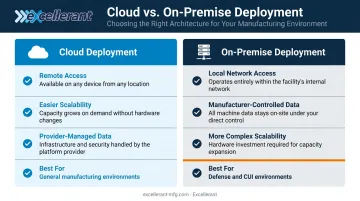
Excellerant offers both. Defense contractors handling CUI-bearing G-code typically choose on-premise to meet CMMC requirements.
How to Implement Machine Performance Monitoring: A Step-by-Step Guide
Step 1 — Assess Your Current Equipment and Goals
Start with an audit of your machines: brands, ages, control types, and existing network connections. Identify your priority KPIs — whether that's OEE, downtime reduction, cycle time accuracy, or ERP data quality. Define what measurable success looks like before selecting any technology. Shops that skip this step often end up with data they can't act on.
Step 2 — Select and Deploy the Right Hardware and Software
Key selection criteria:
- Machine compatibility — Can it connect your full fleet, including legacy equipment?
- ERP/MES integration — Does it integrate with your existing business systems?
- Protocol support — Does it handle MTConnect, OPC-UA, Fanuc FOCAS, HAAS MNET, Mazak Mazatrol, and RS-232?
- Scalability — Can you add machines and users without additional licensing cost?
- Vendor experience — Do they understand manufacturing environments, not just software?
Excellerant's 30 years of machine tool networking experience and universal connectivity across any brand and protocol make it a practical choice for shops managing mixed fleets. The unlimited-user licensing model means adding shifts, departments, or display screens doesn't increase costs.
Step 3 — Connect Machines and Configure Dashboards
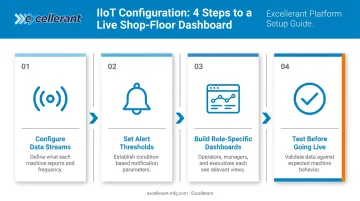
Modern CNCs connect via ethernet or WiFi. Legacy machines connect via serial communications or PLC adaptors. Once connected:
- Configure data streams — Define what data each machine reports and at what frequency
- Set alert thresholds — Establish parameters for condition-based notifications
- Build role-specific dashboards — Operators need job progress and part counts; managers need utilization and OEE; executives need schedule forecasting
- Test before going live — Validate that data matches expected machine behavior
Excellerant's browser-based platform requires no client installs. Any device — tablet at the machine, monitor on the shop floor, PC in the office — accesses the same data through a web browser.
Step 4 — Train Staff and Establish a Continuous Improvement Loop
Technology sets the foundation, but operator buy-in is what actually moves the needle on downtime.
Training should cover:
- How to use the Shop Floor Interface to log downtime reasons and part completions
- How to read performance dashboards and act on alerts
- Why accurate data entry benefits the entire operation
Beyond training, schedule regular reviews — weekly or monthly — where monitoring data feeds into scheduling, maintenance planning, and process improvement discussions. Data that no one reviews doesn't improve anything.
Common Pitfalls to Avoid
- Data overload without actionable dashboards — Showing every available metric to every user creates noise. Build dashboards around decisions, not data.
- Shop-floor resistance without proper training — Operators who see monitoring as surveillance rather than support will undermine the system. Involve them early, explain the benefits, and make the interface easy to use.
- Poor ERP integration — Monitoring data that doesn't connect to business systems stays isolated — and unused. Confirm integration compatibility before deployment, not after.
Frequently Asked Questions
What are the main types of machine performance monitoring?
Three main types: real-time monitoring for instant visibility on the shop floor, condition-based/predictive monitoring that triggers alerts when thresholds are crossed, and historical data analysis for trend identification and benchmarking over time. Most effective programs combine all three.
What are examples of machine performance monitoring tools?
Tools fall into IIoT platforms, standalone machine monitoring software, and performance management modules built into MES platforms. Purpose-built solutions like Excellerant focus specifically on CNC and machine shop environments, offering universal connectivity across any machine brand or protocol alongside OEE analytics and ERP integration.
What metrics should be tracked in machine performance monitoring?
Start with OEE (availability × performance × quality), machine uptime/downtime with root-cause categorization, cycle time versus target, utilization rate by machine and shift, and condition indicators including temperature and vibration. These five cover the most common sources of production loss.
What is the difference between machine monitoring and predictive maintenance?
Machine monitoring is the broader practice — continuously collecting equipment performance data. Predictive maintenance is one application of that data, using trend analysis to forecast failures before they occur. You need monitoring in place before predictive maintenance is possible.
Can machine performance monitoring work with older or legacy CNC machines?
Yes. Legacy machines connect through retrofit serial adapters, RS-232 communications, or PLC intermediary devices. Excellerant specifically supports machines 20, 30, and 40 years old — including behind-the-tape-reader and paper-tape machines — alongside modern CNCs on a single platform. Legacy connectivity is a key selection criterion when evaluating vendors.
How long does it take to see ROI from a machine performance monitoring system?
Many manufacturers see measurable gains quickly — MachineMetrics reported one contract manufacturer improved OEE by 10% within three months of deploying CNC data collection. Downtime reduction and scheduling improvements surface fastest; quality and predictive maintenance gains typically need 6–12 months of accumulated data.