Introduction
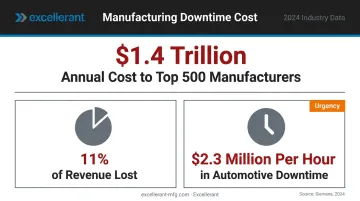
Unplanned machine downtime is one of manufacturing's most expensive and underreported problems. According to Siemens' 2024 True Cost of Downtime report, unplanned stoppages cost the world's 500 largest manufacturers roughly $1.4 trillion annually — equal to 11% of revenue. In automotive, a single idle production line runs up to $2.3 million per hour.
Yet most plants still track downtime manually. Whiteboards, operator logbooks, and spreadsheets routinely miss short stops and micro-stoppages — the events that stack up into massive production losses. Plant managers end up making decisions based on incomplete data, blind to where their biggest losses actually live.
Below, we evaluate the 10 best machine downtime tracking software platforms for 2026 — covering what separates good tools from great ones, how each platform performs, and which fits your machines, floor size, and reporting needs.
Key Takeaways
- Machine downtime tracking software automatically detects, logs, and categorizes every stoppage — replacing manual tracking with real-time, accurate data
- Top platforms differ in machine connectivity (legacy vs. modern), deployment speed, analytics depth, and pricing structure
- Must-have features: automated detection, reason code capture, real-time alerts, OEE reporting, and ERP/CMMS integration
- CNC shops running mixed or legacy fleets get the most direct path to downtime reduction from platforms like Excellerant, which combine universal machine connectivity with integrated DNC
- Most manufacturers see measurable ROI within 3 to 12 months of deployment
What Is Machine Downtime Tracking Software?
Machine downtime tracking software connects directly to production equipment — via PLCs, sensors, machine controls, or protocols like MTConnect — to automatically detect, timestamp, and log every stoppage. The system captures duration, reason codes, and machine state without relying on operator memory or manual entry.
Planned vs. Unplanned Downtime
The distinction matters more than most shops realize:
- Planned downtime — scheduled maintenance, changeovers, tooling changes, shift transitions. These are expected, budgeted, and can be planned around
- Unplanned downtime — unexpected failures, jams, operator errors, material shortages. These are costly, disruptive, and frequently underreported
The separation matters because OEE calculations treat planned and unplanned stops differently — and maintenance planning depends on knowing which category is actually driving your losses. A platform that lumps them together leaves you with metrics that look acceptable while real problems go unaddressed.
Top 10 Best Machine Downtime Tracking Software in 2026
Each platform below was evaluated on what actually matters for downtime reduction — not brand recognition or market size. Evaluation criteria included:
- Automated detection accuracy and reason code capture
- Legacy and modern machine compatibility
- Real-time alerting and analytics depth (OEE, Pareto, MTBF/MTTR)
- Integration options, deployment speed, and total cost of ownership
1. Excellerant
Excellerant is a Connecticut-based manufacturing technology company with over 30 years of machine tool networking experience. Founded on the development of the world's first wireless DNC connection, Excellerant delivers real-time CNC machine monitoring, integrated DNC software, and IIoT connectivity for any machine brand or protocol — modern or legacy.
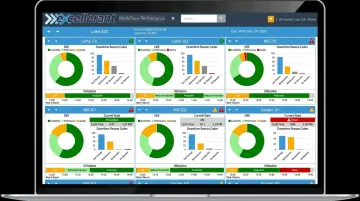
For shops running mixed fleets, everything lands on one unified dashboard. Modern CNCs connect via ethernet or WiFi; legacy RS-232, BTR, and paper-tape machines connect through serial communications or PLC intermediary devices. Supported protocols include MTConnect, OPC UA, Fanuc FOCAS, HAAS MNET, and Mazak Mazatrol.
Downtime detection combines automated machine monitoring with an operator-facing one-tap situation picker for quick reason code categorization — covering personnel, material, tooling, and machine malfunction. Real-time alerts push to mobile devices when stoppages occur.
| Details | |
|---|---|
| Key Features | Real-time machine monitoring and OEE; universal connectivity for any brand or protocol; integrated DNC with one-click revision compare; wireless DNC technology; bi-directional ERP sync (SAP, Oracle, Epicor, JobBoss, Global Shop Solutions); unlimited client access |
| Pricing | Contact Excellerant for pricing; no per-user licensing fees — unlimited users and devices under a single deployment |
| Best For | CNC machine shops and manufacturers with mixed or legacy machine fleets seeking IIoT without replacing existing infrastructure |
2. MachineMetrics
MachineMetrics is a machine monitoring platform built for large-scale CNC environments, based in Easthampton, Massachusetts, purpose-built for large-scale CNC environments. It offers millisecond-level downtime detection, AI-assisted reason code classification, and an extensive API ecosystem for ERP and MES integration.
Downtime Pareto analytics and production schedule intelligence give operations teams unusually precise visibility into where time is actually being lost. The catch: hardware node installation costs and volume-based pricing put it out of reach for smaller operations without dedicated IT teams.
| Details | |
|---|---|
| Key Features | Millisecond-level downtime detection; AI reason code classification; Pareto and OEE dashboards; ERP/MES API integration; production schedule intelligence; unlimited users on core platform |
| Pricing | Volume-based SaaS subscription; cost per machine decreases at scale — contact MachineMetrics for specific pricing |
| Best For | Large-scale CNC manufacturers (50+ machines) with internal IT resources and enterprise deployment budgets |
3. Scytec DataXchange
Scytec DataXchange connects to CNC machines, PLCs, robots, and welders using protocols including MTConnect, Fanuc FOCAS, and OPC UA — making it a strong option for shops running diverse machine fleets. It delivers unified downtime, OEE, and cycle time reporting without requiring additional hardware for most controllers.
Deployment options include commercial cloud on AWS, on-premise, and US-based GovCloud on AWS GovCloud — a useful differentiator for defense-sector shops. Licensing scales with machine count, with all tiers including unlimited reporting and dashboards.
| Details | |
|---|---|
| Key Features | Multi-protocol CNC connectivity (MTConnect, Fanuc FOCAS, OPC UA); unified downtime, OEE, and cycle time reporting; customizable reason code libraries; cloud and on-premise deployment options |
| Pricing | Machine-count-based licensing with volume discounts — contact Scytec for current pricing |
| Best For | Job shops with diverse CNC machine fleets, including defense contractors requiring GovCloud deployment |
4. Predator MDC
Predator MDC is an on-premise machine data collection platform supporting up to 4,096 machines per PC and 70+ industrial machine monitoring protocols. It handles both automated and manual data capture across CNC machines, PLCs, and robots — built for enterprises with strict data governance requirements.
The scale and protocol coverage are unmatched on this list. Where it gets complicated is deployment: upfront licensing investment and IT infrastructure requirements make it a poor fit for shops expecting fast SaaS onboarding.
| Details | |
|---|---|
| Key Features | Supports 70+ industrial protocols; on-premise deployment; automated and manual data capture; scales to 4,096 machines per PC |
| Pricing | Upfront on-premise licensing — contact Predator Software for current costs |
| Best For | Large enterprises with strict on-premise data requirements and existing IT infrastructure |
5. Vorne XL
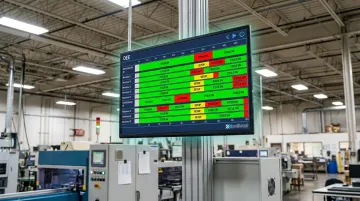
Vorne XL takes a hardware-first approach. Their physical XL Productivity Appliance mounts directly on the production line and shows real-time OEE, uptime, and downtime data in a format every operator on the floor can read. Reason codes are entered via HMI or barcode scanner — no manual logging required.
Built-in reporting covers OEE, downtime, TEEP, changeover, top losses, and total production timeline. That floor-level visibility drives operator accountability in a way software-only dashboards rarely do.
| Details | |
|---|---|
| Key Features | Physical floor display for real-time OEE visibility; automated downtime detection; HMI/barcode reason code entry; built-in OEE, downtime, and TEEP reports |
| Pricing | XL HD+ Productivity Appliance: $4,690; XL Touch Productivity Appliance: $4,990 (one-time hardware pricing) |
| Best For | Manufacturers prioritizing operator-visible accountability and straightforward shop floor downtime tracking |
6. Evocon
Evocon is a sensor-based, plug-and-play downtime tracking platform for small to mid-size manufacturers. Its IIoT device attaches to machines and begins capturing downtime data automatically — operators log reasons through a clean on-floor interface, and the data feeds into real-time OEE and shift-tracking dashboards.
Deployment is genuinely fast — no IT project required. Analytics are less advanced than the enterprise options on this list, but for straightforward discrete manufacturing, the simplicity-to-value ratio is hard to beat.
| Details | |
|---|---|
| Key Features | Sensor-based automated detection; operator reason coding; real-time OEE and shift dashboards; factory overview; ERP integration available |
| Pricing | Per-machine annual pricing — Basic from $189/month per machine |
| Best For | Small and mid-size manufacturers wanting fast, low-complexity deployment |
7. Fabrico
Fabrico differentiates itself by automatically capturing a video clip from the line camera at each machine stoppage, linking that visual evidence directly to a maintenance work order. It also uses PLC data and computer vision for AI-assisted reason categorization and detects micro-stops under two minutes.
The video-to-work-order workflow closes the loop between detection and resolution in a way no other platform on this list does. The tradeoff: Fabrico requires camera infrastructure and carries higher deployment complexity and cost.
| Details | |
|---|---|
| Key Features | Video evidence capture at each downtime event; AI reason categorization from PLC data and computer vision; one-click conversion to maintenance work order; micro-stop detection under 2 minutes |
| Pricing | Contact Fabrico for current pricing |
| Best For | Manufacturers wanting to directly link downtime events to root cause evidence and maintenance workflows |
8. MaintainX
MaintainX is a mobile-first CMMS and work order management platform that digitizes paper-based maintenance processes. Operators log downtime events and work requests from mobile devices, with shift-to-shift communication built in.
Teams get up and running fast — the adoption curve is minimal. One limitation to plan around: downtime analytics rely on operator-entered stop reasons rather than automated machine detection. MaintainX works best alongside an IIoT data layer, not as a standalone detection tool.
| Details | |
|---|---|
| Key Features | Mobile work order management; digital maintenance checklists; shift communication; asset tracking; operator downtime logging |
| Pricing | Basic: Free; Essential: $25/user/month; Premium: $75/user/month; Enterprise: custom |
| Best For | Small to mid-size maintenance teams transitioning from paper-based maintenance processes |
9. Worximity
Worximity connects downtime data to financial impact — showing operators and managers not just how long a machine was down, but the revenue impact of that stoppage. Its Tile-based dashboards deliver real-time production monitoring with detailed reporting and trend analysis, and the platform has a strong track record in food and beverage manufacturing.
It's highly effective for building leadership buy-in around downtime reduction investments. Maintenance workflow integration is lighter than platforms like Fabrico or Fiix.
| Details | |
|---|---|
| Key Features | Real-time production monitoring; financial impact analytics; wireless sensor deployment; Tile-based dashboards; OEE and trend reporting |
| Pricing | Contact Worximity for current pricing |
| Best For | Food and beverage and process manufacturers where financial justification for downtime reduction is a leadership priority |
10. Fiix by Rockwell Automation
Fiix is a cloud-based, AI-powered CMMS within Rockwell Automation's FactoryTalk MaintenanceSuite, designed for enterprise-scale multi-site maintenance operations. It manages multi-site maintenance workflows, complex parts inventory, and carries SOC 2-compliant security with role-based access controls.
According to Rockwell, IDC research shows Fiix users achieve a 27% reduction in asset-related downtime alongside 44% lower labor costs. Implementation typically spans months, and the consulting-to-software cost ratio is high for single-site operations.
| Details | |
|---|---|
| Key Features | AI-powered CMMS; multi-site maintenance management; prescriptive maintenance workflows; complex parts inventory; Rockwell/FactoryTalk ecosystem integration; SOC 2-compliant security |
| Pricing | Enterprise tier — custom/quote-based; contact Fiix for pricing |
| Best For | Large enterprises on the Rockwell ecosystem with multi-plant rollout timelines |
How We Chose the Best Machine Downtime Tracking Software
Platforms were assessed across five core criteria:
- Automated detection capability — does the platform detect stoppages without operator input?
- Reason code capture ease — how fast and accurate is categorization at the machine level?
- Real-time alerting — does the right person get notified at the moment of stoppage?
- Analytics depth — Pareto analysis, shift comparisons, OEE, MTBF, and MTTR reporting
- Deployment speed and total cost of ownership — hardware, licensing, support, and time-to-value
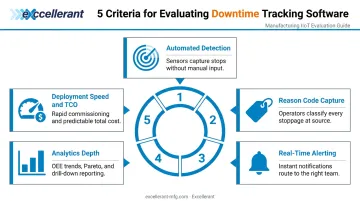
These criteria exist because the biggest selection mistake isn't picking a bad platform — it's picking the wrong one for your fleet.
The Most Common Evaluation Mistake
Most shops select based on brand recognition or feature count rather than fit for their actual machine fleet. The result is either an enterprise platform used at 20% capacity, or a general-purpose tool that can't detect short stops because it lacks native machine-level connectivity.
IoT Analytics research from 2025 puts the stakes in context: 54% of factories still rely on pen, paper, or Excel for production tracking. That's the baseline most shops are improving from — a manual process that misses micro-stops entirely.
What the Right Platform Should Deliver
The selection criteria always tie back to measurable outcomes:
- Reduced unplanned downtime — Siemens reports predictive maintenance can cut unplanned downtime by up to 50% and maintenance costs by 40%
- Improved OEE — Avalign Technologies increased OEE by 30% after deploying automated monitoring (via MachineMetrics)
- Faster ROI — 30 minutes of additional machine utilization per month per machine can cover software costs (Scytec)
If a platform can't demonstrate those outcomes for your operation type, it doesn't belong on your shortlist. A long feature list in a demo means nothing if the tool can't connect to your machines automatically.
Conclusion
Machine downtime tracking software in 2026 spans a wide spectrum — from simple shop-floor visibility tools to full enterprise IIoT platforms. The right choice comes down to four factors: your machine fleet composition (legacy vs. modern), operation scale, budget, and whether automated detection or maintenance workflow management is your primary need.
Go beyond feature checklists when evaluating options. Prioritize platforms that connect to the machines you have today — including older CNC equipment that won't be replaced anytime soon — and that scale without forcing costly re-implementations later. What matters is actionable data where your operators actually work, not polished dashboards built for executive reviews.
For machine shops and manufacturers looking for a proven IIoT partner, Excellerant is worth a close look. Built on 30 years of machine tool networking experience, the platform offers:
- Universal connectivity for any machine brand or protocol — including legacy serial equipment
- Single-platform visibility across old and new machines, no infrastructure replacement required
- No per-user licensing fees, regardless of how many people need access
Get in touch with the Excellerant team or request a demo to see how it fits your operation.
Frequently Asked Questions
Frequently Asked Questions
How much does downtime cost in manufacturing?
According to Siemens' 2024 True Cost of Downtime report, unplanned downtime costs the world's 500 largest manufacturers around $1.4 trillion annually — roughly 11% of revenue. Automotive lines lose up to $2.3 million per hour when idle. Most companies underestimate their true losses because manual tracking misses short stops and micro-stoppages.
What are downtime analytics products?
Downtime analytics products are software platforms — often paired with hardware — that collect, categorize, and analyze machine stoppage data. Basic tools log events and generate reports; advanced IIoT platforms layer in Pareto analysis, OEE calculations, shift comparisons, and AI-assisted root cause identification to surface the patterns driving production losses.
What is downtime analysis?
Downtime analysis is the process of reviewing logged stoppage data to identify patterns, root causes, and improvement opportunities. Key metrics include MTBF, MTTR, OEE, and planned vs. unplanned downtime ratios — giving maintenance and operations teams the data to prioritize fixes.
What are the different types of downtime?
There are two categories:
- Planned downtime — scheduled stops for maintenance, changeovers, tooling changes, and shift transitions
- Unplanned downtime — unexpected failures, jams, operator errors, and material shortages
Tracking both separately is essential for accurate OEE calculation. Unplanned downtime is typically the largest and most preventable source of loss.
What features should I look for in machine downtime tracking software?
Prioritize automated stoppage detection, reason code capture, real-time alerts, OEE and Pareto reporting, and ERP or CMMS integration. For shops with older equipment, legacy machine compatibility is non-negotiable — many platforms require modern controls and won't connect to older CNCs at all.
Can downtime tracking software work on older or legacy CNC machines?
Yes. Most modern platforms support legacy equipment through retrofit sensors, PLC connections, or serial protocols. Platforms like Excellerant are specifically designed for universal connectivity — connecting RS-232, BTR, and older serial-controlled CNCs alongside modern machines on one platform, without requiring replacement of existing controls.